Pages

Friday, 22 November 2013

Selsey Sea(l) Watch

Desperate for a few more ticks for the year I decided to do a sea watch at Selsey Bill. The wind was bitter and just a tad west of north as I hunkered down behind the concrete sea wall on the bill. Out of the wind it was pleasant - just a hint of warmth in the sun. Some of the usual suspects were about but distant, Red-breasted Merganser, Great Crested Grebe and several flocks of Common Scoter. A Great Northern Diver appeared close inshore so I returned to the car for the camera - you guessed it - gone when I returned. Two birders who passed by confirmed that it was still about further down the coast, having set everything up I chose not to relocate.

After what appeared to be a promising start things quietened down considerably. I was jerked out of my daydreams as I spied a large black object close in to the groynes. I wasn't sure what it was but when I saw the whiskers in the sunlight I knew straight away that it was a seal and a big one at that. It hung around for ten minutes and then disappeared. As the tide rose things got even quieter, a distant flyby of some Wigeon the only thing of note.

L


So it was up sticks and away to the north wall, where the wind was even more bone chilling. At least the water levels on Breech Pool have receded and at long last there is an expanse of mud for the waders. In residence was a single Ruff, Mallards, Wigeon and Teal. Several Snipe were loitering at the edge of the reeds and amongst the spread out Black-tailed Godwits a colour ringed specimen to record WG-OB.


White Green - Orange Blue.

Lots of lovely mud.....

.....and water.


One bonus was that due to the low temperature the air quality was superb for photography, just could have done with a few more targets 


Thursday, 21 November 2013

Sacre Bleu!

As I have mentioned previously, if possible, I try to record any ringed birds that I see. With the camera it is easy  - photograph the rings and when post processing crop as heavy as necessary to read the information - simple! However, in the past I have been known to grumble about how long it takes to receive a reply - never again.  Late Tuesday evening I searched the Euring Website for the particular project that rings Med Gulls with white rings prefixed 3 and found the e-mail address for Camille Duponcheel. I constructed a report:

Mediterranean Gull: White Leg Ring 3K50
Sighted: Lepe, Hampshire, United Kingdom
Date: 19/11/2013 10:34 UTC Position: 50.79N   1.34W  Nat Grid Ref SZ462 987
Picture attached,
 
This was sent at 2157, imagine my surprise as I downloaded my email the next morning to find a reply timed at 0511 - astounding service. Most of the ringing groups request that you keep the database output confidential but it is OK to give an extract.
 
Mediterranean Gull/ Mouette Melanocephale 3K50 was ringed at Antwerp, aged >3CY, on 22/04/2006  and there have been 11 subsequent sightings. This bird obviously likes the Hampshire coast as 9 these have been in the county.
 
 
Whilst waiting for the Lesser Yellowlegs to show, I did some experimenting with the camera, for birders the following shot of a Dunnock is quite unremarkable, it is a bit washed out, the depth of field is ridiculously small and there is a fuzziness to it. But I took it with the Canon 1D MkIV coupled to stacked x2 and x1.4 extenders and the 500mm f4 lens. The camera is tricked into believing that only a x2 is connected so it behaves as a 1820 mm F8 lens that autofocuses - albeit a tad slowly. I am hoping that this will prove useful to record birds when sea watching. Shot at f8 1/320s ISO 800. Post processing - cropped, noise reduction and sharpening. 


Today's outing was a visit to the WWT at Arundel, with the weather set wet, windy and cold, our reasoning was that the hides would afford some protection as well as the chance of a bird or two. Especially as there have been recent sightings of Spotted Crake, Bittern and Bearded Tit.

Before parking at WWT we had a quick visit to Swanbourne Lake, just in case there was something out of the ordinary. Not this time - plenty of Black-headed and Common Gulls, a disappearing Grey Wagtail, Tufted Ducks and a multitude of Coots.


On to WWT where we visited each hide in turn but despite loitering around we found very little, the birds were doing exactly the same as us - sheltering from a bitter north-easter. Back to the Visitor Centre via the boardwalk and the Wildfowl collection. I couldn't resist a photograph or two of a couple of colourful residents - very smart individuals indeed. The best part of the day was the steaming mug of tea in the restaurant.


Tuesday, 19 November 2013

Lesser Yellowlegs (II)

Martin and I have some sort of mantra that goes - See bird - Photograph bird - Improve photograph, of course not always in one visit.

So in perfect weather conditions we returned to the location of the Lesser Yellowlegs at Lepe Country Park. If you have seen the photographs we obtained on our first visit, then you will understand readily that virtually any photograph would be an improvement. Of course central to this plot is that the bird is actually visible. After a fairly long wait in a brisk northerly breeze we spotted the target, yet again a long way off. Then after another considerable wait the bird re-appeared on the pool in front of us but at a range that I would call "acceptable record shot". After expending a large amount of camera memory I remain disappointed with the results. With the bird withdrawing to the back of the pool we too withdrew - to the welcoming warmth of the car park cafĂ© for a pot of tea for two.


 Next on the list was a revisit to Jetty Lagoon at Pennington Marsh for the Long-billed Dowitcher as Martin wanted to try to improve on his previous shots. Just as on the last visit, the bird was reluctant to show itself and remained in the reeds in the close company of Snipe.


If I see a ringed bird I normally try to get a record, today was no exception. As we waited for the LY to show I noticed two Mediterranean Gulls on the scrape, one of them carrying a ring - 3K50, a report will be submitted tomorrow - watch this space!


Friday, 15 November 2013

Long-billed Dowitcher

The long staying Long-billed Dowitcher at Pennington Marsh had become a bit of a bogey bird for me. My three previous trips were "dips", too little water, too much water and too late and yet again too much water.  Martin had elected to do the Great Grey Shrikes at Waltham Brooks but for me they were just a photo opportunity when the LBD would be a life tick - no brainer. I left before 0600 and was at Keyhaven Marshes, the latest location for the bird, just as the sun rose.

When you are on your own, searching for a shy bird over a large expanse of ground is difficult, after a couple of hours I was rather disheartened. All I had found was a single Redshank, a dishevelled Shelduck, two hen Pheasants and a distant Roe Deer. On my slow trudge back to the car park I met a local birder who said "wrong place mate - you want to be on Butts Lagoon". So I picked up the pace but as I reached the car I met two other birders who reckoned they had the latest gen - "you want to be on the second lagoon(Fishtail) mate". So I got in the car totally confused and drove round to Sturt pond to try and locate the Red Breasted Goose - no chance.

Back to Pennington Marsh and Fishtail lagoon - another negative. The water levels are still very high so using my rather twisted logic I searched all the lagoons looking for a bit of dry land and a wader of any description. Finally on Butts lagoon I located about 10 Common Snipe and several Lapwings so I decided to stake out this patch in the hope that the LBD would be here. After about half an hour the commotion of squabbling Snipe attracted my attention and sure enough a grey bird with yellow legs dashed through and hid in the reed tussocks. Finally I had enough of a view to confirm it - at long last a Long-billed Dowitcher.  The bird was reluctant to come out, happy to snooze in deep cover, suddenly all the birds took flight, possibly spooked by a raptor. I managed to track the bird in my viewfinder as it made a rapid flight out and an equally rapid return to its favourite cover.

Not a surprise, when this bird arrived it was in summer plumage and it is now well and truly in its winter grey garb.

In its favourite roost
"Snipe sized"


 All the right ID points: Long bill, grey-green in colour, slightly decurved
                                      White trailing edge to wings.
                                      White "cigar".
                                      Prominent supercilium.
                                      Greenish yellow legs.


At one stage this was all I could find!!


Wednesday, 13 November 2013

A Day at Dungeness

 
Today the plan was to go east and at 0700 we departed under cloudless skies for Dungeness. As always we made a quick detour, this time to Pevensey Bay to view the site of the recently reported Red Breasted Flycatcher. Of course we had no illusions that we would see the bird but as we parked next to the bushes a Robin flew up and we both nearly had a heart seizure. Continuing east in ever increasing traffic the next stop was Scotney Pits, huge numbers of Greylags were grazing on the banks but it was the usual flock of Barnacle Geese that held our interest. As I had previously recorded, in the flock were seven hybrids. On the sightings board at the visitor centre at Dunge they had them as Bar Headed x Barnacle crosses. I believe them to be Emperor x Barnacle crosses, confirmed from photographs on my January 3 2012 Blog by two independent sources in Sweden and Germany.


We were tempted to stay and examine the Greylags in detail for something exotic but instead we pushed on to Dungeness and promised ourselves that we would return later.

Arriving at the ARC side we parked up and were treated to a flyby of two Marsh Harriers - the only ones we saw all day. The view from the screen was pretty depressing as the water levels are very high and just a few wildfowl were present, very little real estate being available for waders. Giving up here we motored down to the beach, parking by the power station. A walk across the shingle to the outfall was rewarded by masses of gulls but sadly no Little Gull. A quick visit to the Obs site and we were off back to Boulderwall Farm for a glimpse of the Tree Sparrows, a lightning call to the visitor centre to confirm nothing exotic was about and back to ARC. From the hide we had great views of Water Rail, Kingfisher, Glossy Ibis  and Great White Egret and a full supporting cast of the usual suspects.


The supporting cast


Finally we decided to return to Scotney Pits to scan the Greylags, we made it half way along the road to Camber and we had to turn back as the road ahead had been closed. As we did the U-turn we noticed on the road, two dead birds. What followed really put a damper on my day. I investigated the two bundles of feathers and found them to be female/juvenile Merlins and they had not long been dead as both were warm. I am a fairly hard bitten old b****r but this was not a pleasant sight.


As for the Greylags - we didn't bother.

Tuesday, 12 November 2013

Lesser Yellowlegs

Today west was best, the early morning weather was atrocious but sliding south easterly. As we journeyed along the A/M27 into Hampshire the clouds gradually lifted and the sky brightened. In fact, on reaching Lepe Country Park, home of a recently reported Lesser Yellowlegs, there was a distinct band of blue sky and the promise of sunshine. As we approached the scrape to the east of the car park two birders were already in attendance, unfortunately their report was a "no show". We patiently hung around but very little appeared, a Peregrine being harassed by several gulls provided brief entertainment.

Precious time was being wasted so we left for Pennington Marsh for another go at the Long Billed Dowitcher. Last time we visited Pennington the pools were almost bone dry and devoid of birds, this time there was too much water and no exposed mud - therefore no birds. One day we will get it right!

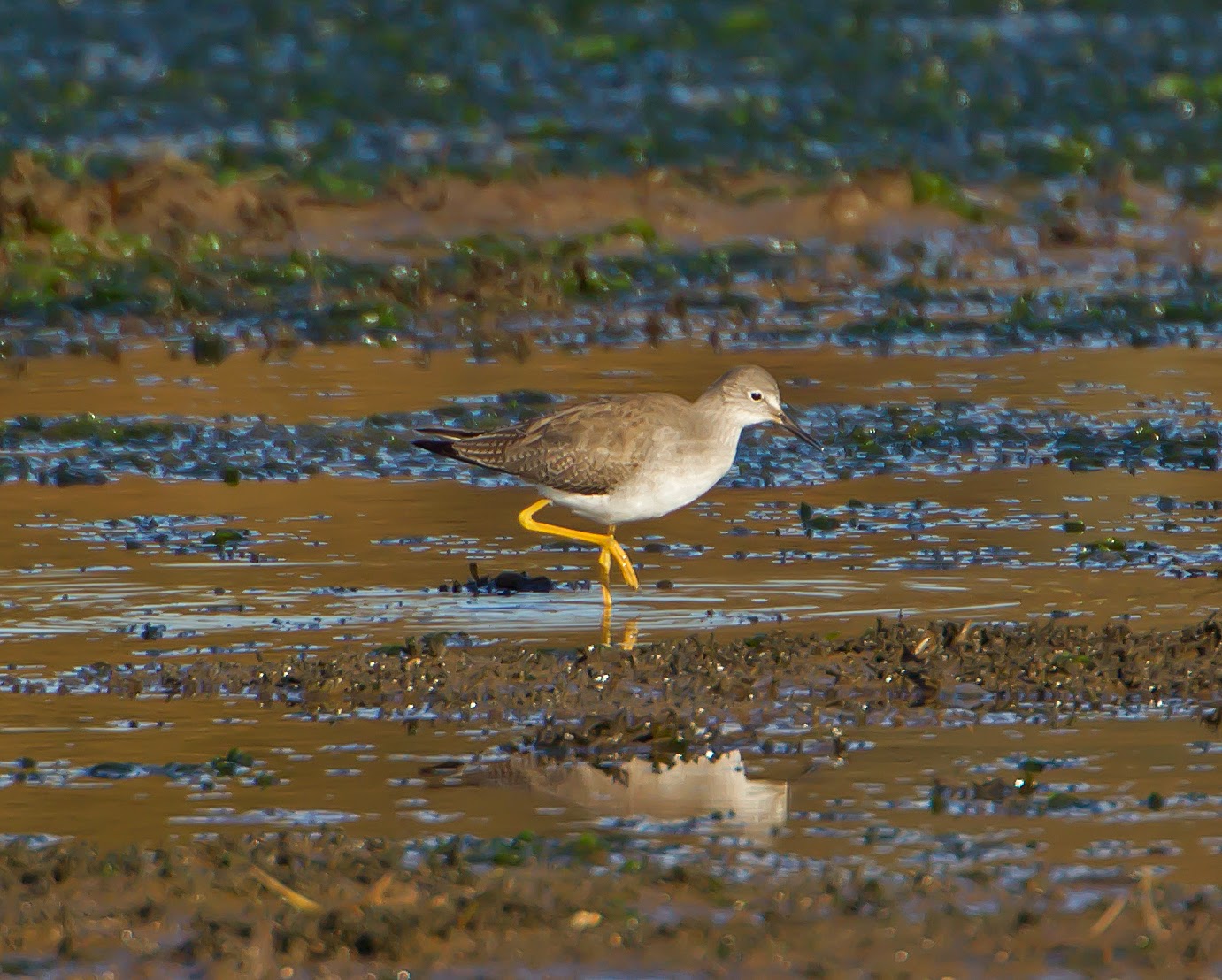
Back to Lepe for another go and as we parked up we were extremely lucky to meet Roy and Keith, the birders who had been present earlier in the day. Great news! - they had been informed of the bird's presence on the scrape adjacent to the Dark Water. Martin and I were armed with cameras and binoculars, in the haste to get to the bird I had left the scope in the car. However, our companions carefully scanned all the birds and - success. Not a bird to take your eyes away from as you can soon latch on to a Redshank in error. Not the best photograph of the week but at long last a confirmed tick for Martin - many thanks to Roy and Keith for their assistance, sorry the shots were not better quality but it was an awful long way off.


Just to pad out the blog - two photographs of a Pintail, the best looking duck around.


Sunday, 10 November 2013

Dartfords

As my seven readers will know, Sunday is not a usual birding day for me. However, today had some pretty strong extenuating circumstances to allow an exception to the rule. The weather was clear and cool overnight and promised bright sunshine through the day. So at five bells into the morning watch I set out for the Sussex commons.  On our secret birding map there is large X and the caption below states "Here be Dartfords". How could you doubt the veracity of such a map as, before the sun had risen above the trees and touched the tops of the heather, the first bird was perched in front of me, albeit at a distance.  I then constructed a makeshift hide, up sun of the likely spot, and patiently waited for the next subject to arrive - and it did.


Having captured two birds I thought I was on a roll, how wrong can you be, a rather cool easterly breeze sprang up and the birds disappeared. I continued to wait patiently, the hide must have been effective as at least three dog walkers passed by and failed to detect my presence. Neither did the dogs, which perhaps says something for my new deodorant.

As the deck watch indicated six bells of the forenoon watch there came a steady procession of cyclists in yellow jackets, families dressed overall in dayglow fluorescent lycra  of both  lurid pink and yellow hues and even more dogwalkers. Time to set a course for home.