Pages

Showing posts with label Ruff. Show all posts

Tuesday, 13 September 2016

Red-necked Phalarope

Phew What a Scorcher!  The hottest September birding day for 105 years and we were out in it. Actually, out on the north wall at Pagham it was a beautiful morning. Oddly, the wind was from the east and it was pleasant to be out. However no one had told the birds - just the usual suspects to be found - Black-tailed Godwits, Greenshank, Snipe, a couple of Dunlins and a raft of Redshanks inhabited the exposed mud. A Ruff flew in and after a swift bath, hid amongst the godwits. So we waited for something to turn up and boredom soon set in so we departed. On the way out we met several birders and we ended up heading for Thorney Island and the Red-necked Phalarope. This bird has been present for over a week and we have eschewed a visit because usually it is at a distance, affording little opportunity for a photograph.

Anyway, as we approached the Little Deep, Martin spotted it almost immediately, happily feeding away at a fair distance. Luckily, several times during our stay the bird ventured closer to our position and we were able to get some decent record shots.


As we left I mused aloud that it was great to have a lifer but that it was a shame that it wasn't a Sussex tick too. Now my Geography isn't bad and I do have some qualifications and experience in navigation but it did come as a bit of a shock that I could be so wrong - of course Thorney Island is in Sussex - Doh! Ticks all round then. Not only that, whilst updating my records I noticed another milestone - this is my 300th bird species to be photographed - where the definition of a photograph is that it is a recognisable bird - not just a clump of pixels.

The previous day we had ventured to Titchfield Haven in search of the Semipalmated Sandpiper, unfortunately a dip, a not unlikely event as I don't seem to have much luck at this venue. Anyway I considered five hours in one of the hides to be sufficient effort and we left without a sniff of the bird. Of course other birds were present and I whiled some of the time away capturing an obliging Ruff and a confiding Snipe.


Finally some shots recorded on days when I didn't have enough to blog. First an inquisitive Buzzard that gave us the once over on Honer Farm.


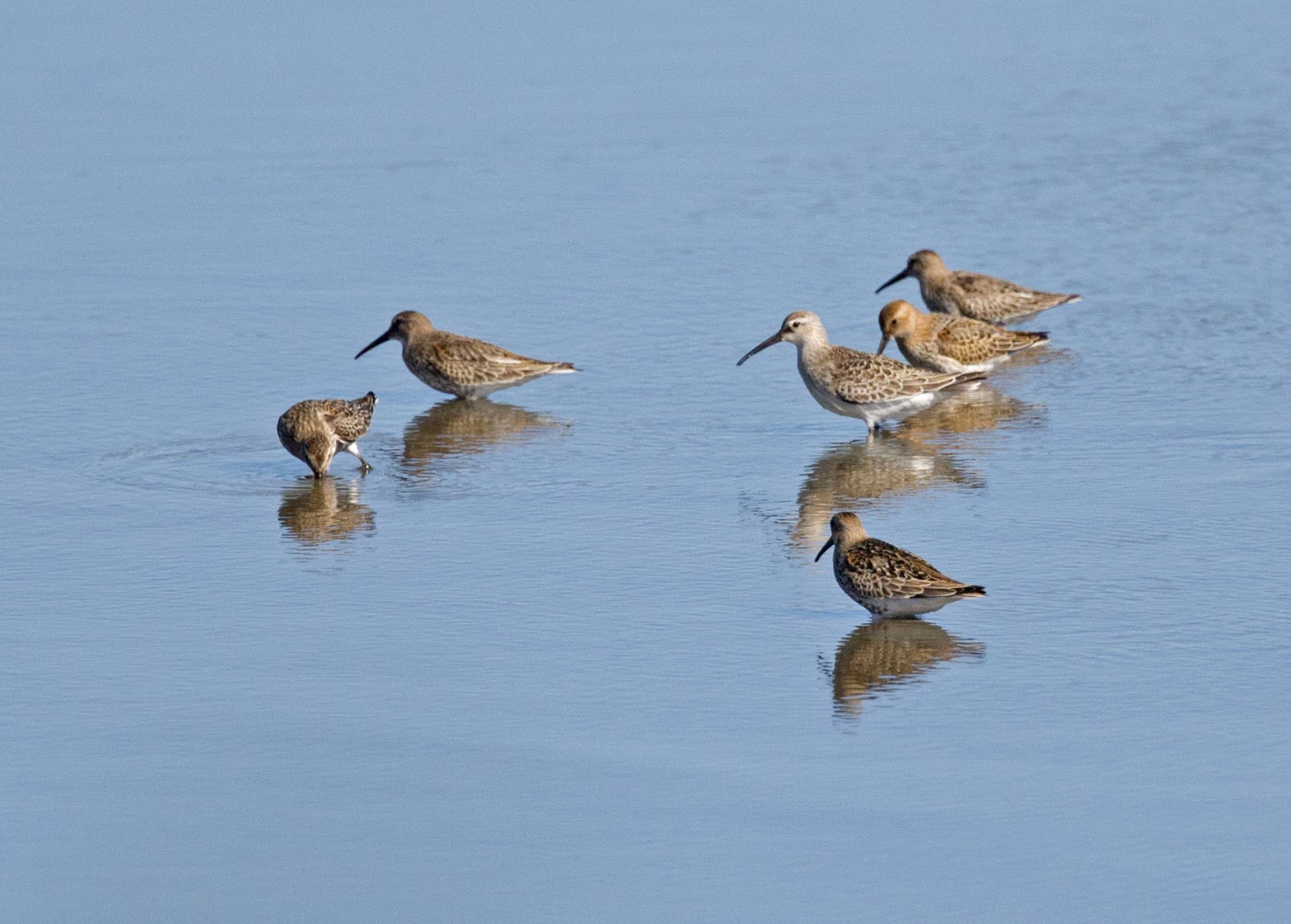
 Followed by two birds that have almost given me the slip this year - Wryneck and Curlew Sandpiper - maybe next year.



And finally the yellowest Yellow Wagtail of the year


Tuesday, 18 August 2015

Pectoral Sandpiper

When there are lots of postings of Brown Hairstreaks  on the web it means that the butterfly season is ending and it is time to resume birding. So, today I did. Martin picked me up and we made for our trusted venue - Breech Pool on the North Wall at Pagham. It was really nice to see the pool looking as it should - a balance of mud and water - rather than the dusty desert that it had become earlier in the year. Plenty of birds too - good numbers of Lapwings and Black-tailed Godwits, several Snipe plus the usual mix of waterfowl.

Peter was in attendance and he had seen what he thought was a Little Stint but it had subsequently disappeared round the back of the pool. I managed to locate a Ruff in with a flock of Redshanks but alas no LS. Then a bird appeared on the mud at the eastern end of the pool and we were on it like a flash, neither of us considered that it was anything other than the aforementioned Little Stint. Later analysis and reports from other birders confirmed that we had been a tad hasty and that it was in fact a Pectoral Sandpiper. Seasoned birders will wonder how one can make such a mistake - well with small shorebirds I find it incredibly easy - best practice is to take as many shots as possible and perform hindsight analysis at home. Another 20 years of birding and I might get the hang of it - problem is I will need someone to push the wheelchair.


The bird was then joined by a cracking Ruff, beautiful plumage and colour, unfortunately the sun refused to shine and all my photographs lacked that much required feather detail. Still the Pec was a new one for me and it is good to be out birding again.


Another record today - at the back of the pool a colour ringed Black-tailed Godwit was roosting with a few of his companions, I try to record these birds when I find them and send off a  sighting report with an accompanying photograph. Today was no different except that I sent the report to José Alves  who rings birds on the Tagus estuary in Portugal. I received a detailed reply in 12 minutes!!

OG(flag) + OB was ringed as an adult male on 4.02.12 at Seixal Tank, Tagus Estuary, Setúbal, W Portugal and there have been 12 subsequent sightings in Holland, Belgium. Portugal and the UK.


Monday, 9 December 2013

Deepest Kent

I have to start with an apology to Mike Hook, I promised that the next time we ventured deep into Kent I would e-mail him so that we could meet up. Sorry Mike, we sat outside my gate dithering about where to go today, West or East and finally Martin decided that we would again chase White Fronted Geese. 70 WFGs had been reported at Swale, so we left post haste for the Isle of Sheppey.  Road works on the A23 and M25, coupled with mist conspired to delay us but we finally crossed the shiny new bridge and I was filled with anticipation. I had previously told Mike that I hadn't visited Leysdown since 1967 and he told me that it probably hadn't changed much since then. Well Mike you were dead right, it is still the shanty town that I remember from so long ago, not a place to write home about but it does have a certain shabby chic.

The road down to Shell Ness provided a large measure of discomfort but the sign that greeted us was certainly a shock. I don't know which joker put the sign up but it is almost a perfect description of the place, a remote area. If the journey through Leysdown was depressing this forsaken place was the epitome of desolation. Hardly a bird present, just a few Meadow Pipits on the marsh, some lonely Pied Wagtails and 20 or so Shelducks out on the mud.

Dire warnings about deepest Kent

Somewhat crestfallen we made our way back to Elmley, another wide open space with very few birds present. However, I must explain that we only made the long drive to the visitor centre, not to the reserve itself. We passed plenty of Lapwings, Curlew and a handful of Black-tailed Godwits on the way. As we arrived we could see two birders peering intently over the wall, "What have you got?" we enquired. "Two owls in a box" was the reply and we scurried off for the cameras. Not the best of shots of a Barn Owl but I promised I would publish one for the birders who we met.


Thoroughly disheartened, with not many birds to be seen and even less captured by the lens, we decided to complete our foray into Kent at Oare marshes. Our last visit there was brilliant and we anticipated that we would, at last, get something for the blog. Slightly disconcerting was the "road closed" sign on the way in, I guess that the flooding had been fairly serious in these parts, but the barriers had been removed and we could actually get down to the reserve.

Yet again Oare came up with the goods, high water levels meant that most birds had decamped to the flooded fields rather than the customary pool. Lots of Ruff, Teal and Snipe to be photographed. Then, an obliging Water Rail squealed to let us know of its presence and boldly swam across in front of us, rather too close for the lens I fear. Finally a stunning display of a Marsh Harrier quartering the reed beds on the pool. We managed to view several altercations with the resident Crows - great entertainment.


Too close - move away


With the sun slowly sinking in the west and there being insufficient light for any more photography, it was time for home - cracking day after all!
 

Friday, 22 November 2013

Selsey Sea(l) Watch

Desperate for a few more ticks for the year I decided to do a sea watch at Selsey Bill. The wind was bitter and just a tad west of north as I hunkered down behind the concrete sea wall on the bill. Out of the wind it was pleasant - just a hint of warmth in the sun. Some of the usual suspects were about but distant, Red-breasted Merganser, Great Crested Grebe and several flocks of Common Scoter. A Great Northern Diver appeared close inshore so I returned to the car for the camera - you guessed it - gone when I returned. Two birders who passed by confirmed that it was still about further down the coast, having set everything up I chose not to relocate.

After what appeared to be a promising start things quietened down considerably. I was jerked out of my daydreams as I spied a large black object close in to the groynes. I wasn't sure what it was but when I saw the whiskers in the sunlight I knew straight away that it was a seal and a big one at that. It hung around for ten minutes and then disappeared. As the tide rose things got even quieter, a distant flyby of some Wigeon the only thing of note.

L


So it was up sticks and away to the north wall, where the wind was even more bone chilling. At least the water levels on Breech Pool have receded and at long last there is an expanse of mud for the waders. In residence was a single Ruff, Mallards, Wigeon and Teal. Several Snipe were loitering at the edge of the reeds and amongst the spread out Black-tailed Godwits a colour ringed specimen to record WG-OB.


White Green - Orange Blue.

Lots of lovely mud.....

.....and water.


One bonus was that due to the low temperature the air quality was superb for photography, just could have done with a few more targets