Pages

Showing posts with label Lesser Yellowlegs. Show all posts

Wednesday, 7 January 2015

Lesser Yellowlegs

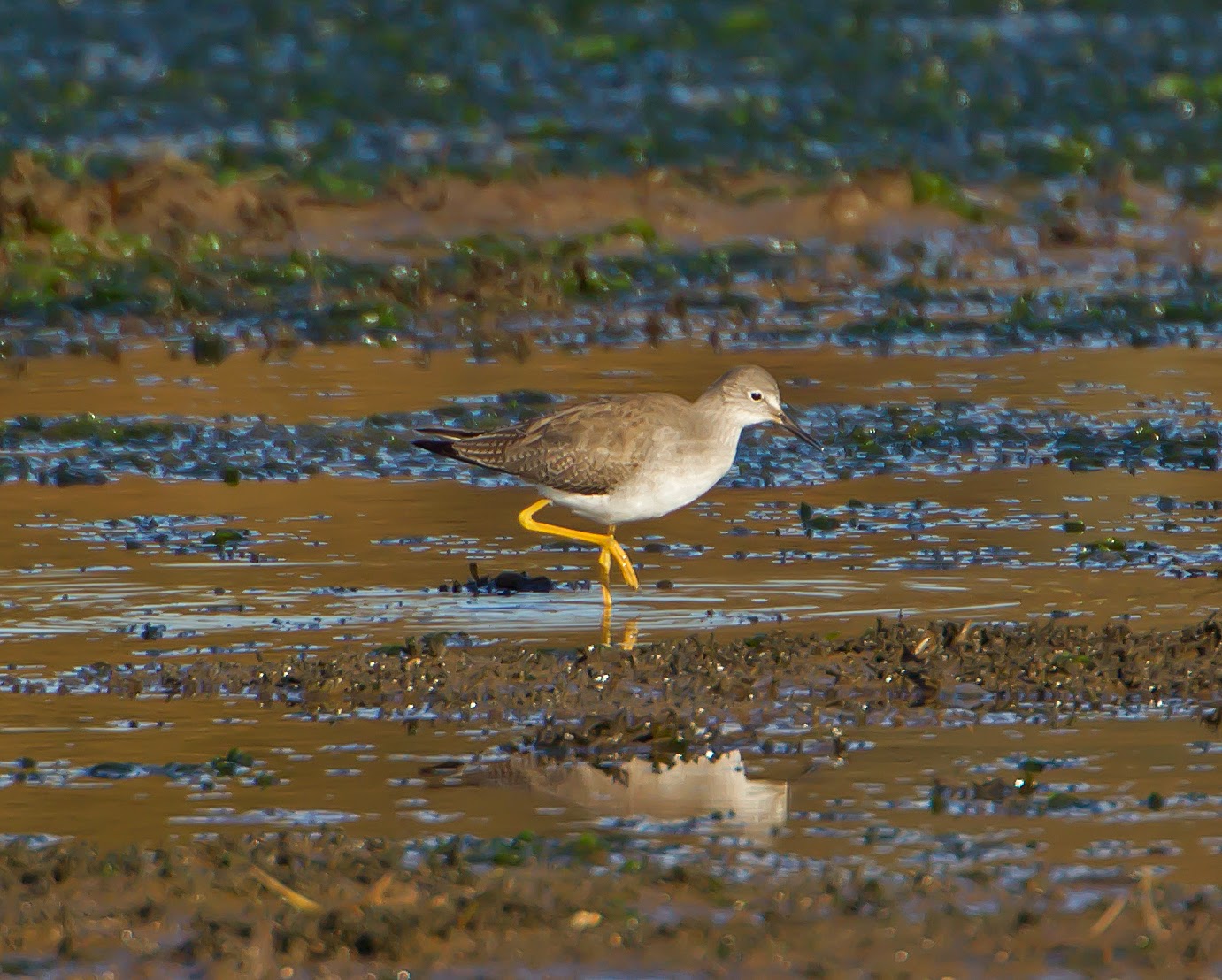
Another cracking day out, 2015 really has started with a bang. Today it was the Pett Level Lesser Yellowlegs, an obliging bird that has favoured one of the pools close to the road. So, in cool and windy conditions, with just a hint of sunshine, we parked on the road in what we thought would be the best spot. Like minded birders had done just the same, ahead of us was David Gardiner scanning the venue. We didn't have to wait long before the bird arrived and then it was a scramble to get the cameras sorted out. Just a short opportunity to capture some reasonable shots as a passing Turnstone spooked the bird and it retired to the back of the pool, taking refuge in some reeds. However, it wasn't long before it reappeared and it gradually worked its way to a position close to the road.


Having captured some really good shots of what can be a difficult subject we bade farewell to David and made our way to Scotney Pit.  The drake Scaup was found remarkably easily and not only that, it was swimming strongly towards the west, well into Sussex!! I dutifully scanned the mass of Greylags but could not turn up anything unusual. Amongst the host of Tufted Ducks and hordes of Wigeon there were some splendid looking Pochards, alas a bit far away for a photograph.

Next we visited Denge Marsh for the long staying Cattle Egrets. I had been fortunate to have them close last Friday and was confident that Martin would have the same opportunity. Sod's Law prevailed, when we arrived there was only one bird present and at quite a distance. Martin took a few record shots and as we started to return to the car, sure enough two Cattle Egrets took to the air and landed within 10 yards of the roadside fence - right in front of where we had parked - so close that I couldn't resist a few more records. The  afternoon light enhancing the orange tinge that both birds were displaying on their heads.

I guess the "softness" comes from shooting through a chain link fence!


Next up had to be Boulderwall Farm at RSPB Dungeness, well how could you venture into Kent without paying the Tree Sparrows a visit. Oddly there were quite a few Reed Buntings about in the cottage garden and they were quite distracting. I spotted and counted six Tree Sparrows but by the time other birders were scanning the brambles the birds had melted away into the scrub. I could tell by their looks that they thought I was mistaken and that I had been conned by the Reedies.

Then it was over the road to ARC and the Hanson Hide. As we entered the hide we were directed to an obliging and successful Kingfisher that was perched to the right of the hide.
Really nice to finally catch up with Mike Hook again - some four years after our first meeting in one of the hides at Rye. Somehow over the intervening years we have managed to miss each other by just minutes at several venues in deepest Kent.


Whilst in the hide we were treated to a distant views of Marsh Harrier and Bittern. Closer to the hide we managed to capture several active Chiffchaffs and an industrious Great Tit, pulling the reedmace heads to pieces.


A quick call to the visitor centre and the two closest hides in search of a Smew but by now the wind was whistling through and most birds had gone for cover. On the way out we stopped again at Boulderwall and we finally caught up with the Tree Sparrows, probably well into double figures present but again mixed in with the Reed Buntings. I knew I wasn't mistaken!

Thursday, 2 January 2014

A New Year's Birding Begins

The first birding day of the New Year is always different. For those of you who don't keep lists then this will be a bit baffling. Today was a day when the slate was wiped clean, each bird stands equal amongst others as it has not yet attained "year tick" status. The rare Lesser Yellowlegs that we were seeking at Lepe Country Park was on a par with the Song Thrush that we noted on the path to Stansore Point. Eagerly we logged Chaffinch, Greenshank and Redshank before spotting the obliging Lesser Yellowlegs. Even the Dunnock and Green Woodpecker were welcome attractions, birds that in the forthcoming months will be more or less ignored whilst we search for more exotic specimens. Back at the car park three Pied Wagtails ensured that we had reached double figures, disappointingly the sea was empty.

A short drive along the flooded coast road, stopping to view the Dark Water gave us Oystercatcher, Teal and Wigeon. A flyby of Shoveler and Greylag, the list was ever increasing


After a while we came to a fork in the road, which way? Martin chose Inchmery Lane and we made for Exbury House - an excellent decision. As we drove along what is the entrance to the Beaulieu River we could see, through the trees and into the sun, that there were lots of birds out on the mud. We parked next to the spot where the Exbury River enters the main river, in the stream a Little Egret and then totally out of the blue a Long-tailed Duck which remained close enough for a decent shot.


What - no rain??

 As we returned to Lepe, we noted a Buzzard being mobbed by Crows, a flock of Redwings and another Buzzard, an extremely pale breasted specimen, sat out in the warm morning sun. The list was growing. Where next?  A short detour to Hythe Marina where A Great Northern Diver had been reported, alas nothing but two Mute Swans and a House Sparrow - Tick - Tick!!


Next was a visit to Hill Head just along from Titchfield Haven where some friendly birders conned us on to two Velvet Scoter. Nothing to be seen of the Kittiwakes that had been frequenting the surf line just before we arrived. As we left, the Mallard flock on the creek provided an addition to the list. The Yellow-legged Gull that inhabits Stokes Bay had gone missing, probably due to the amount of walkers both human and canine using the beach. So, as planned, we ended up at Walpole Park to record "Waldo" the Ring-billed Gull, exactly a year and one day since I had last snapped him. Several Common Gulls had us fooled for a time but finally he arrived at his favourite location by the pond. His glinting yellow eye and more "menacing" demeanour clinching the tick. Apparently this is Waldo's eleventh winter spent in Gosport where he is always welcome.

"Waldo"


A Common Gull - not the same class as Waldo

 So at 12:30 on our first day out there was a quiet satisfaction of a good day already in the bag. There could be only one venue to spend the afternoon - the North Wall at Pagham - no brainer.  On the wall we were given New Year greetings  from the two Daves who gave us a list of birds present and then happily told us that the Little Owl had disappeared some time earlier. Never mind, the recent heavy rain had flooded the fields to the north and the birds were taking advantage of the available food. Black-tailed Godwit, Curlew, Lapwings and wildfowl in abundance. It took some time but I finally located the single Ruff and a flyby of a Common Snipe was well received.

Then Dave Shepherd received a call from Ian informing him that two Whooper Swans were on Ivy Lake at Chichester Gravel Pits - a nod is as good as wink to a blind man and off we went. On arrival, before we located the Whoopers, we added Great Crested Grebe, Gadwall, and for Martin, a confirmatory Shoveler as he had missed the earlier flyby. Then as the light faded we found and recorded the Whoopers. Finally, thanks to Andrew House, we added Pochard to the list.  A great day out with the final tally being 67 species, 66 seen and one heard, well what more do you want of the Cetti's Warbler.


Oddly enough the small birds are missing from the list, whether we weren't looking or it may be that the westerly breeze had deterred them from venturing forth, finches and tits were notably absent.


Tuesday, 19 November 2013

Lesser Yellowlegs (II)

Martin and I have some sort of mantra that goes - See bird - Photograph bird - Improve photograph, of course not always in one visit.

So in perfect weather conditions we returned to the location of the Lesser Yellowlegs at Lepe Country Park. If you have seen the photographs we obtained on our first visit, then you will understand readily that virtually any photograph would be an improvement. Of course central to this plot is that the bird is actually visible. After a fairly long wait in a brisk northerly breeze we spotted the target, yet again a long way off. Then after another considerable wait the bird re-appeared on the pool in front of us but at a range that I would call "acceptable record shot". After expending a large amount of camera memory I remain disappointed with the results. With the bird withdrawing to the back of the pool we too withdrew - to the welcoming warmth of the car park cafĂ© for a pot of tea for two.


 Next on the list was a revisit to Jetty Lagoon at Pennington Marsh for the Long-billed Dowitcher as Martin wanted to try to improve on his previous shots. Just as on the last visit, the bird was reluctant to show itself and remained in the reeds in the close company of Snipe.


If I see a ringed bird I normally try to get a record, today was no exception. As we waited for the LY to show I noticed two Mediterranean Gulls on the scrape, one of them carrying a ring - 3K50, a report will be submitted tomorrow - watch this space!


Tuesday, 12 November 2013

Lesser Yellowlegs

Today west was best, the early morning weather was atrocious but sliding south easterly. As we journeyed along the A/M27 into Hampshire the clouds gradually lifted and the sky brightened. In fact, on reaching Lepe Country Park, home of a recently reported Lesser Yellowlegs, there was a distinct band of blue sky and the promise of sunshine. As we approached the scrape to the east of the car park two birders were already in attendance, unfortunately their report was a "no show". We patiently hung around but very little appeared, a Peregrine being harassed by several gulls provided brief entertainment.

Precious time was being wasted so we left for Pennington Marsh for another go at the Long Billed Dowitcher. Last time we visited Pennington the pools were almost bone dry and devoid of birds, this time there was too much water and no exposed mud - therefore no birds. One day we will get it right!

Back to Lepe for another go and as we parked up we were extremely lucky to meet Roy and Keith, the birders who had been present earlier in the day. Great news! - they had been informed of the bird's presence on the scrape adjacent to the Dark Water. Martin and I were armed with cameras and binoculars, in the haste to get to the bird I had left the scope in the car. However, our companions carefully scanned all the birds and - success. Not a bird to take your eyes away from as you can soon latch on to a Redshank in error. Not the best photograph of the week but at long last a confirmed tick for Martin - many thanks to Roy and Keith for their assistance, sorry the shots were not better quality but it was an awful long way off.


Just to pad out the blog - two photographs of a Pintail, the best looking duck around.


Wednesday, 25 September 2013

Spotted Crake

With the local birding being easily described as "slack" and with Martin's encouragement, we decided to venture to pastures new. Today we visited the North Kent Coast taking in two venues that, on the day, were chalk and cheese.

First up was the RSPB reserve at Cliffe Pools, we had something of a challenge getting there as I don't think the RSPB have got round to putting up any of the familiar signs. It's always difficult on a first visit, as we made the mistake of parking a long way from our quarry, when with a bit of experience we could have been much closer. Anyway, target here was the Lesser Yellowlegs that had been reported on one of the Black Barn Pools. The Cliffe reserve covers a huge area, in fact 237 ha of saline lagoons and brackish pools created by old clay diggings and river dredgings. My first impressions were of vast amounts of water inhabited by few birds, I guess that will change with the onset of winter. On the fairly long walk to find the bird we saw very few other species. However, the place is alive with dragonflies and judging by the amount of Buddleia bushes on the trail, will be a brilliant butterfly haunt in the late summer months. Today, just a few Large Whites and a single Red Admiral.

On the trail we spied a familiar car and we knew that John Stanton and Mick Davis were about, all we had do was find them and we would be home and dry. A local birder gave us encouragement by telling us that the bird was present and pointed us in the right direction. As we arrived we were greeted by John and Mick and were treated to views of the LY using Mick's scope - cheers guys!

The bird had relocated to a far corner of an adjacent pool and was barely identifiable using binoculars. Given the light conditions were pretty grim, shooting into the sun and with a considerable glare from a slight mist, I didn't bother to take the camera from the case. At least it was a life tick. Having waited for some time in the hope the bird may come closer I became bored and went in search of camera fodder. Apart from a Kestrel on a post, that flew as soon as I mounted the camera, I saw little else. Then I made the second mistake of the day - I decided to return to the car park by completing the circular walk of the reserve, arriving at the car a full hour after Martin.

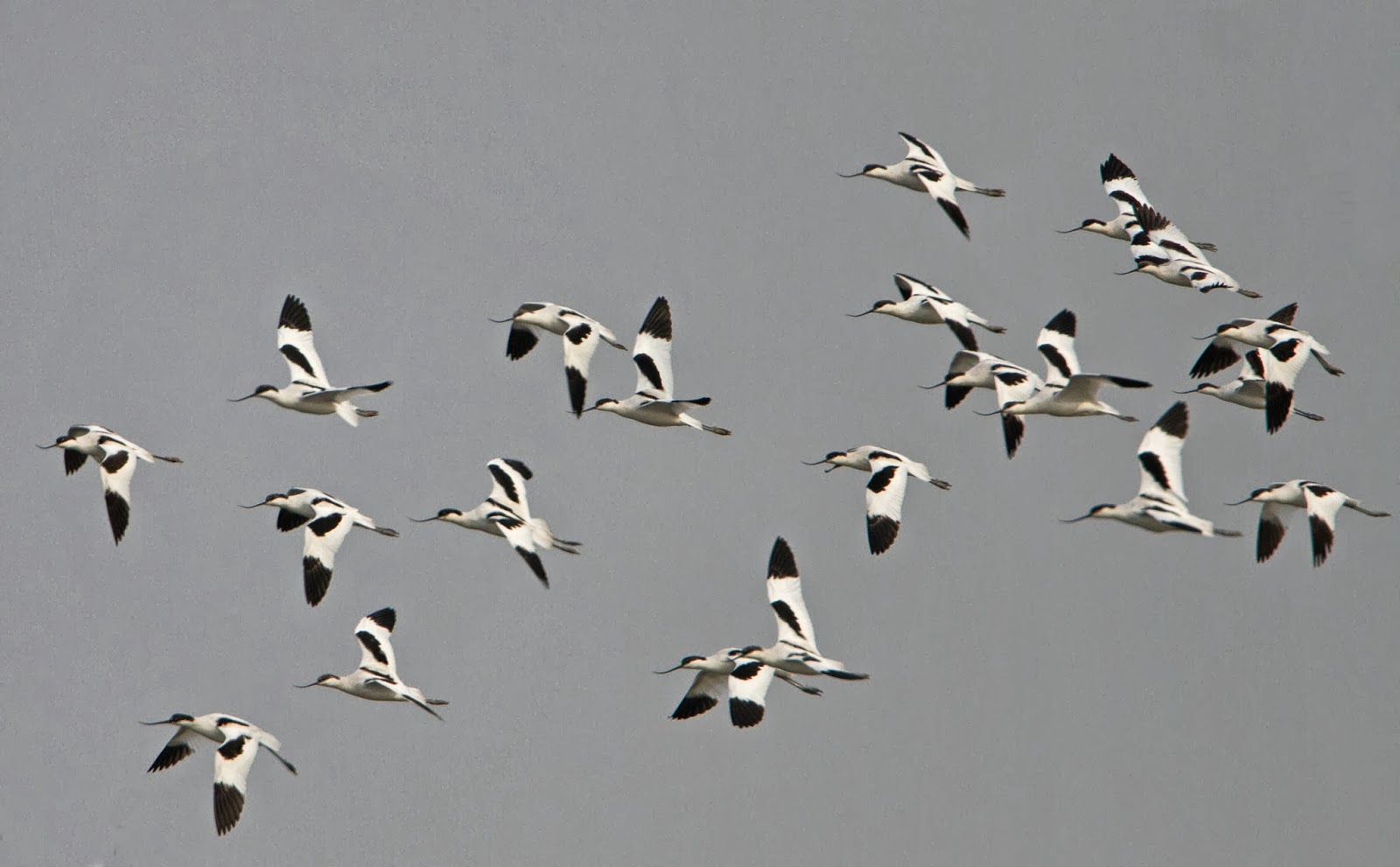
Somewhat delayed we pressed on to our second venue, Oare  Marshes. What a difference, as we approached we could see large quantities of birds, both on the water and in the air. Again we met John and Mick who were just leaving but took the time to give us a tip on the Spotted Crake. At first we spent some time just observing the birds from the roadside, the sheer numbers of Black-tailed Godwits and Avocets were stunning, all with a considerable supporting cast of Golden Plovers and Ruff.


Having expended sufficient pixels on birds sitting and in flight we made our way round to the East hide in search of the SC. We were left in no doubt as to where the bird could be found as there were several birders intently peering into a small reed covered pool just next to the path to the hide. Being polite, I asked several how long they had been waiting - the general response being about an hour. So we were lucky that after about ten minutes the bird made an appearance, scurrying around the mud like a small rat and in some minor altercation with a Water Rail. Getting a clear shot was virtually impossible but with such a great looking bird we stayed in the hope of capturing the ideal shot. Oddly, when every other birder had left, the bird came out on to the grassy bank and vanished into a bramble bush. Martin and I agreed that it had "probably gone to roost" when it left the bush, crossed the path to the hide and disappeared into the undergrowth. We were both so surprised that all we managed was a shot of the path itself!


A few more shots of the Golden Plovers from the roadside in a rapidly setting sun and it was time for home. Probably the longest birding day of the year for me and one of the most satisfying.


Ringed Birds

Of course, amongst so many birds there had to be some with rings:


 Postscript: I submitted a sighting report for this bird and received a reply from Peter Potts the following day informing me that RYO RNR was first ringed at Harty, The Swale, Kent on the 1st Sept 2012 and all subsequent sightings have been at Oare Marshes.


A sighting report of this Ruff has been made to a Dutch Ringing Group - awaiting developments.
 
 Postscript: No reply as yet but I suppose that it is early days, I reckon that 50% of the reports I make never get any info back.