Pages

Thursday, 12 September 2013

Autumn Lady's Tresses, Anchor Bottom

Following three days of really enjoyable birding I managed to find enough energy to get out and about to Anchor Bottom. I have been trying to get there to record the Autumn  Lady's Tresses and feared that I would be too late. Not quite, although some of the blooms had gone over, there remained masses just coming into full flower. On the northern - south facing, slope of Anchor Bottom there are hundreds, probably thousands, of specimens between the entrance at Dacre Gardens and the old fence line.


Some are tall......

.....and some are small.


On our recent travels Martin and I had come across a Robin's Pincushion. However, today I found a really magnificent set of specimens, well worth photographing. The rose bedeguar gall, Robin's Pincushion gall or moss gall develops as a chemically induced distortion of an unopened leaf axillary or terminal bud, usually on the Field Rose or Dog Rose, caused by the parthenogenetic hymenopteran Gall Wasp, Diplolepis rosae.


A ginormous cluster!!
 
Butterflies are plentiful, particularly blues, but there are still Clouded Yellows to be found, though not willing to settle. Most specimens are now well past their "sell by" date.
Now that's what I call "well worn"
The thistle heads that were the source of food for the butterflies are now providing seed to ever increasing numbers of Goldfinches.


The season of mellow fruitfulness is upon us and the first signs of the "fungus fest" are showing, nothing like a good cowpat to provide the sustenance. This is possibly a Snowy Inkcap, Coprinopsis nivea  which prefers the weathered dung of herbivores.


And finally.............Eyebright, Euphrasia officinalis

Wednesday, 11 September 2013

Pennington Marsh

Having had a day out on the Cuckmere and found, much to our dismay, that similar to other locations it was devoid of birds, we decided that a day at Pennington was in order. Especially as my birding companion had visited there some weeks ago and reported that there was a veritable cornucopia of avian life. So, when we arrived we were dismayed to find that the water levels in the lagoons were at a very low level and it was immediately apparent that very few birds were present.

The targets for the day included Black Tern, a possible elusive Long-billed Dowitcher and some close up views of Curlew Sandpiper. Alas, the well laid plans of mice and birders often go awry. Having watched the Dunlin and Ringed Plovers  move slowly towards the sea wall as the tide approached, boredom set in and we made our way to the "jetty"  on the beach in front of Pennington Lagoon. This was the reported location of the juvenile Black Tern, as we approached all we could detect were a few Turnstones and some obliging Pied Wagtails.

Then, thanks to some local birders, we located two juvenile terns on the poles to the left of the jetty. It was at this point wishful thinking and poor birding skills set in, as in real time we corporately incorrectly identified several birds. My excuse is that they were distant, I only had my bins and that "Collins" was in the car.  We knew that we had seen the Black Tern and recorded it, but confirmation of other birds had to wait until post visit analysis could be carried out on the large amount of photographs we had captured.

Anyway, below are a representative set of record shots, taken at long distance. The salutary lessons that I have learned are - never jump to conclusions  and that the plumage of juvenile terns is remarkably variable.


  Common Tern (juv) with Black Tern (juv)
 
  Common Tern (juv) with Black Tern (juv)
 
 
3 Common Tern (juv)


Common Tern (juv)


Common Tern (juv)


Common Tern (juv)


Common Tern (juv)


Ermm???   Commic!


Common Tern (juv) and Sandwich Tern 


Sandwich Terns


Sandwich Tern


Tuesday, 10 September 2013

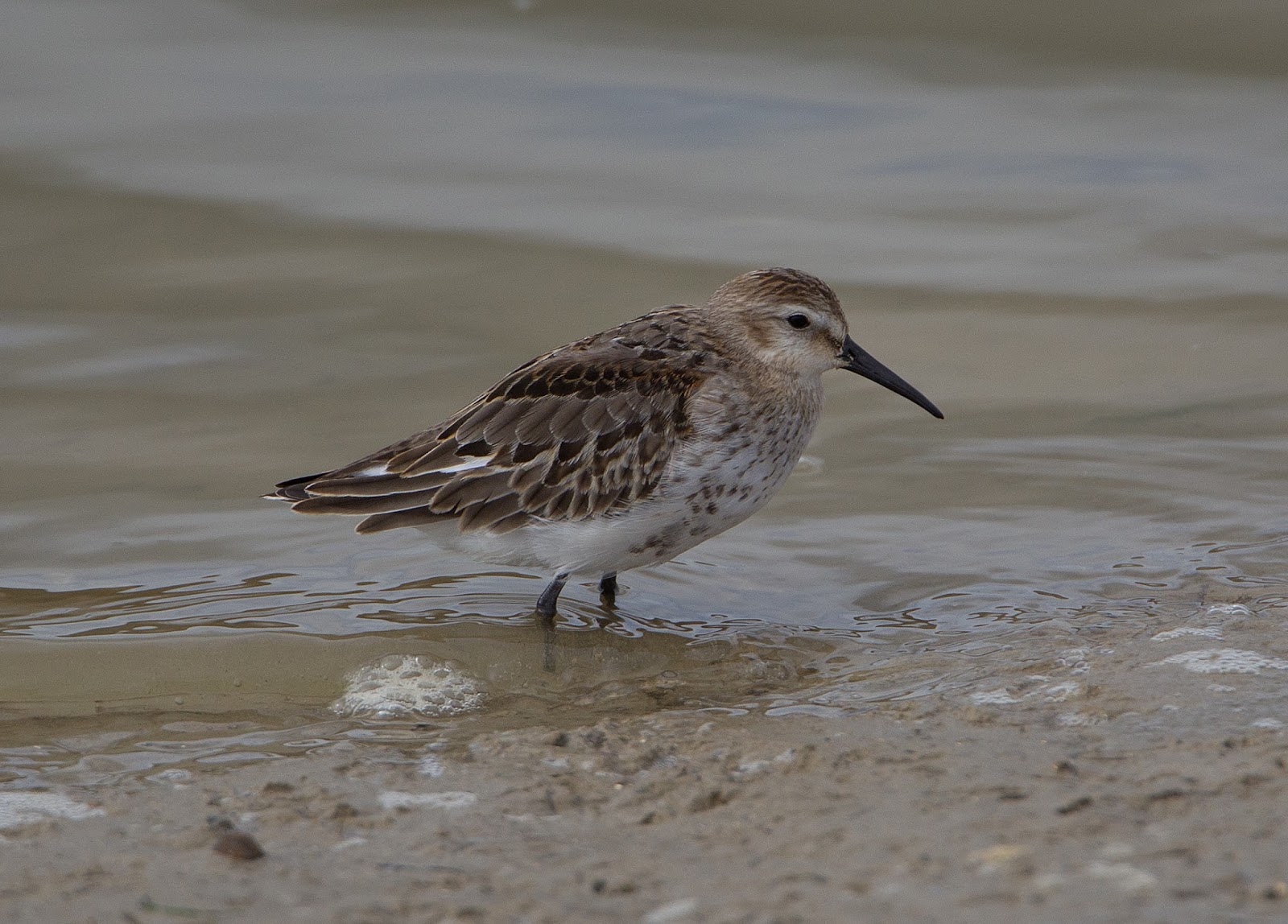
Dunlin

Some may view the Dunlin as an insignificant bird, but I happen to think they are quite charming and today they were most obliging, filling a hole in our birding day. We started at Arlington Reservoir, a search for the Little Stint that has been so amenable to having his photograph taken. Unfortunately a circuit, anti clockwise, of the lake revealed nothing more than an extremely flighty Greenshank that certainly wasn't going to pose.  Apart from the dam wall there are very few areas of the reservoir where you can get good views of the water, vegetation has been left to grow virtually unchecked, both around the margins and in front of the hide, a very poor state of affairs. I would have left a comment making this point but there wasn't even a piece of chalk for the recent sightings board in the hide. So after a cup of tea we left for the Cuckmere to try and locate the Curlew Sandpipers adjacent to the Golden Galleon.

A walk along the river gave sufficient encounters with the Dunlin to allow me to give the new camera a go, early results are very pleasing. Apart from the Dunlin we had Ringed Plover, Bar-tailed Godwit and distant views of Spotshank and Sandwich Terns.


Whilst we were down towards the end of the river there was an "incident" at the first "Sister" of the Seven Sisters. Whether someone had fallen or been trapped by the rising tide I know not, however we were very soon surrounded by blue flashing lights and helicopters.


Saturday, 7 September 2013

Out and About

Birding on a Saturday is unusual for me, I much prefer to be out and about on weekdays when there are fewer people around. But! today there was a choice of two twitches, Farlington Marshes offering 95% chance of Ospreys and Saltdean offering a 5% possibility of Dotterel. Our strategy was to venture west to Farlington and to keep a weather eye on Rare Bird Alert just in case someone discovered the proverbial needle in the haystack.

Farlington was fairly quiet, a few cars in the car park, perhaps the dark grey clouds on the horizon, which promised squally heavy rain, were keeping people at home. Additionally, the temperature was noticeably cooler than of late. We made our way past the "shed" to the east side, few birds were about on the marsh and fewer flying. Arriving at  the harbour we scanned all the islands, particularly North Binness but no Osprey, we continued and completed a circuit of the marsh, noting Sparrowhawk, Kestrel, Meadow Pipit and a "charm" of Goldfinches. Luck was on our side as we caught the tail end of a shower leaving us only slightly damp. It must have been quiet as neither of us took our cameras from the case.

Next up was a visit to Budd's Farm sewage works, a place I have been intending to visit since last year. Scanning the lagoons gave all the usual suspects - Gadwall, Tufted, Mallard and sharp-eyed Martin picked out a single Shoveler.  One last scan of the harbour, all the islands from a different viewpoint returned nothing. A scan of port hand spars in the channel revealed a Cormorant and a rather dark bird eating something, just the jizz of the bird had me back to the car for the scope - success - an Osprey fairly distant, dining on a fish. No problems with the ID but a passing boat spooked the bird and it relocated to the grass of Long Island. Tick in the box but no photographs.

A visit to Hayling Ferry Point gave nothing of note so we relocated to Chichester Harbour just down from Northney Marina. Not a lot of activity except for some Black-tailed Godwits relocating on the high tide, as we walked back to the car park around fifty birds were jostling for ever decreasing real estate.

This was followed by a visit to Pagham North Wall just as the tide was peaking. On Breech Pool all the usual suspects, Common Snipe, Teal, Black-tailed Godwits, 3 Spotted Redshanks and a sprinkling of Lapwings. On the stones were Wheatears and several Yellow Wagtails occupied the path. A raptor flyby caused a quickening of the pulse but after a small chase it proved to be a Common Buzzard rather than anything exotic.


Plenty of Swallows over the pool, all looking well fed and in fine fettle for the upcoming journey.


Africa - are you sure Dad??


Wednesday, 4 September 2013

Red-backed Shrike

As we drove to Rottingdean this morning I was sure that we were too late for the Red-backed Shrike. After all it had been around for four days, surely it must have gone. On the roadside only one vehicle was parked, not many birders about then. However, as we approached the location there was a single birder peering intently into the field, it was still here!! Then what followed was the most pleasant twitch that I have ever experienced, an obliging bird, perfect conditions and getting close to the subject. I hasten to add, for those birders that believe birders with cameras are demons, that in this case it was the bird that chose to come close to the photographer.


The bird fed happily all the time we were present, finding a plentiful supply of grasshoppers, bumble bees and sundry other unidentified insects. Even when several more birders turned up the bird remained content to feed from the wire fence some twenty yards distant.


On the wires were the usual suspects, Wheatears and Whinchats. One Whitethroat took exception to the close proximity of the RBS and made a comical half-hearted protest.


Nice to meet Paul and Bill on their local patch and thanks for the info on another possible bird close by.