Pages

Tuesday, 7 July 2015

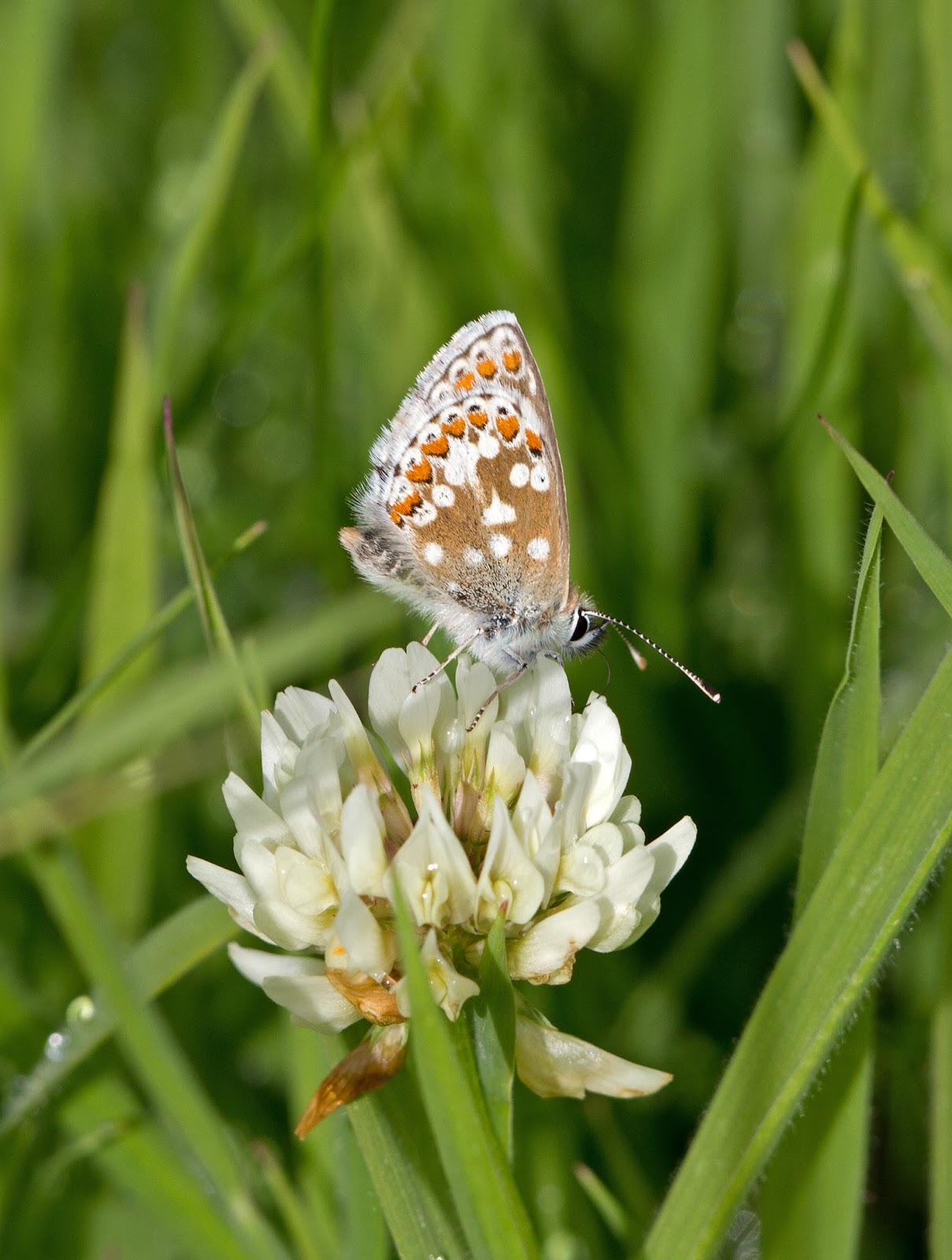
Northern Brown Argus

A couple of weeks ago Martin and I had decided that another visit to Scotland was in order, with both birds and butterflies as our targets. Elvis the King Eider in the Ythan estuary was the primary quarry. Martin was keen to get the tick and I wanted some improved shots from those I took in May. Of course, the Law of Sod kicked in and Elvis did a bunk northwards just after we had booked our hotels. So we modified our programme and the final list was a mix of birds and butterflies. My emphasis was on the butterflies - wanting just five to complete my UK mainland list, but Martin was just as keen to get them in the bag.

So early on a fine sunny morning we left our hotel in Berwick upon Tweed and made our way to St. Abb's Head, where there is a reserve set aside for the Northern Brown Argus. On the walk towards the head we were distracted by Ringlets and some strange day flying moths of a species that I had not seen before. In the breeze they proved almost impossible to photograph and I never obtained a satisfactory shot.

When we reached the NBA reserve we split up so that we could search a larger area. It wasn't long before we found a resting specimen and I was well pleased to record my 54th species of butterfly. I reckon we probably had double figure sightings and having recorded sufficient specimens we decided that we could use the time better at our next venue. Of course on the way back to the car we were seduced by the offerings of "The Old Smiddy", where we had a bacon butty and a cup of tea as we had foregone breakfast in order to maximise our time here. We shared our table with an incredibly tame male Chaffinch who had a few pickings from us.




St. Abbs


We made excellent progress, the Edinburgh City Bypass flew past and we were making good time to Trinafour, a village off the A9 north of Blair Atholl. David Gardiner had told me that Mountain Ringlets can be found in this location, and close to the road. Unfortunately the weather deteriorated and drizzle set in. We searched in vain and found just a few Small Heaths flying. I think we were just a tad early as the season in Scotland has been delayed by prolonged bad weather earlier in the year. Additionally, there have been extensive groundworks here, large new electricity pylons being installed obviously require heavy plant over the area. So we hit the road for our third target of the day, the Osprey nest that Liz and I had visited during May, I was keen to know if there had been any breeding success.

Sure enough, as we arrived we could see the male Osprey was sat in exactly the same place - an old dead tree adjacent to the nest. Encouraged by the female he went off in search of food and amazingly returned in very short order with a Pike. Now we had clear views of both adults and at least one youngster. Unfortunately tempus fugit and we had to press on to our overnight accommodation in Grantown on Spey. Not a bad day - two ticks from a "wanted" list already.


The previous day we had broken the journey up north with a visit to RSPB Dearne Valley - or Old Moor, as it used to be called. Here we had views of the drake American Wigeon, sadly distant and the photographs are not the best. Sitting in the hide with the rain coming down I entertained myself photographing a Green Sandpiper. Later we went in search of the Little Bittern that had been resident for some days, alas a no show and as I sat in the "Bittern Bus Stop", an open shelter overlooking the reedbeds of the reserve, I had an overwhelming desire to nod off.


Thursday, 2 July 2015

Nightjars on the Commons

Last night Martin and I shared a Sussex Common with several Nightjars and a horde of voracious midges. It is quite enthralling, waiting for the sun to go down and to hear the first churring. Unfortunately last night we also had a helicopter fly by, a barking dog and in the distance an outdoor concert  with the obligatory bass thump. Never mind, at around 2145 the first faint sounds were heard. Soon a closer bird flew by and perched for us and then commenced a fairly loud churring session - wonderful!

The photographs were taken in near darkness - for the photographers - Canon 7d Mkii coupled with a Canon 300mm F2.8 and 1.4 extender - hand held. The remarkable thing is that I managed to get any sort of recognisable shot as I had the camera set to ISO 10000 and a shutter speed of 1/30 of a second.


Taken at 21:56!

Being so close afforded the opportunity to record the churring, flight calls and wing clapping that are characteristic of the bird.

Sonogram of the first recording, sorry the blog doesn't run to synchronised sound and vision.


Press play for the audio track


For the Geeks. Olympus LS11 with Sennheiser Me66/K6. Post processing in Audacity. Sonograms in Raven Lite.

This is a second recording of the same bird, this time with a high pass filter applied at 320 Hz, helping to remove some of the ever present aircraft noise. The swatting sounds remain, I am afraid the midges were getting through my defences.


Monday, 29 June 2015

Marbled White

It was nice to go out in what felt like summer weather, though it doesn't take much of a rise in temperature before we are complaining "It's too hot". Martin had come up with a plan that took in birds, butterflies and dragonflies and we more or less stuck to it. First up was Church Norton, though we did have a peek at Ferry Pool where a splendid summer plumage Spotshank was in residence, just too far away for a decent shot. On the spit at Church Norton the harbour looked a bit devoid of birds and I suspect that the Hudbrel was some way up the creek.

Our next venue was the meadow adjacent to Whiteways café on the road out of Arundel. Lots of Marbled Whites on the wing and one or two just emerging, providing some superb opportunities for photography. I did my annual check of the roundabout, risking life and limb in the traffic, to count the Bee Orchids, just 7 this year and going over already. The Pyramidal Orchids go from strength to strength and it was nice to find a good stand in the field itself.


The female has a distinct yellow/brown rear underwing....

....and a similar colour on the leading edge of the forewing


Next venue was Lords Piece, plenty of hyperactive dragonflies, we found Emperor, Broad Bodied Chasers, Four Spot Chasers and a Common Darter. A full supporting cast of Damsel Flies and the odd Meadow Brown, Small Skipper and the ubiquitous Marbled White.


If an interloper comes near the wings go vertical


Very showy caterpillar of the Vapourer - should have recognised this one straight away - the four "shaving brushes" are very characteristic.

Noon Fly, Mesembrina meridian - thanks to Jim Langiewicz for the ID


Having visited RSPB Pulborough Brooks for Martin to resupply with bird feed we eschewed the long walk to Black Pool for more dragons and left for Woods Mill. At the entrance to the Mill, just beneath the bridge we found a juvenile Water Rail, apparently photographed by everybody and his dog - I guess we happened to be the last. A Turtle Dove was purring away merrily, deep within the leaf cover of one of the taller trees, shame that it didn't venture up on to its usual perch on the dead tree overlooking the lake.


A great day out, lots of varied material in the viewfinder and plenty of pictures for the blog - what more can you want?

Wednesday, 24 June 2015

Holly Blue

After a week of gallivanting up hill, over moor and heath and through forest it was pleasant to just sit in the garden during warm and sunny weather. However it wasn't long before one or two interesting specimens hove into sight. First up, a Holly Blue, a female I think, apparently looking for some suitable egg laying sites.


 The pond has its usual quota of  Damsel Flies and an Azure Blue posed obligingly.


Other finds were a Soldier Fly ....


... a shield bug, Coreus marginatus decided that the fresh laundry was a reasonable place to take in the sun...


...finally a Speckled Bush Cricket, of which our garden has many, also posed in the warm sunshine.

Tuesday, 23 June 2015

Black Hairstreak

At the turn of the year, when I decided that I would try to complete the list of UK butterflies, I thought that the Black Hairstreak would be the hardest to get. Of course I didn't factor in the miserable weather we had whilst we were in Scotland making the Chequered Skipper a dip. So when we set off for Oxford yesterday morning I wasn't optimistic that the day would be successful. As we travelled round the M25 the skies were leaden and it was raining hard, not really June weather at all and certainly not conducive to a butterfly hunt. As we passed through Stokenchurch cutting on the M40 the clouds lifted and there were patches of blue, by the time we reached Bernwood Forest things had brightened considerably.

Sitting in the car park we realised we had a bit of a problem, Bernwood Forest is huge,  where exactly do we find these elusive butterflies? We had expected to gain info on the site but the only people present were dog walkers - a bit of a dilemma. A phone call to Leigh Prevost and we had an exact location and we were on our way. Thanks Leigh.

Finally, just after mid-day, Martin located our first specimen, halfway up a tall privet bush, not really accessible and difficult to photograph, just as we were getting sorted a bee took exception the to the butterfly and saw it off. Never mind - a result  and the wait began for another.

During the afternoon we saw at least six specimens, none of which came close, save for one tatty specimen and that didn't hang around long. So we obtained what I would call record shots - not those captured where everything is in clear focus and the background is clear - still beggars can't be choosers and the list now stands at 53. Looks like the next journey will be northwards.


My first Black Hairstreak


The only one to come down to our level and it is well worn!


So in the last week I have been lucky enough to add three lifer butterflies and the Terek Sandpiper - am I happy? Not really - this morning I missed the 10  Bee Eaters in East Sussex!

Sunday, 21 June 2015

Terek Sandpiper

Just after 1100 this morning I noticed a Tweet from David Buckingham posting a sighting of a Terek Sandpiper at Church Norton, Pagham. I sent an email to Martin followed by a text but sadly no reply, I knew that he would be busy as it was Father's Day so I let it slide, birding on a Sunday is not my bag - all those crowds. Anyway, late afternoon I received a call from Martin, paternal duties now discharged, should we give it a go?

The result was that we found ourselves at Church Norton amidst the throng. First birder we met was David himself who, flushed with the success of the Terek, was now chasing the Hudsonian Whimbrel. The sandpiper had disappeared with the rising tide and a line of birders was stretched out on the spit waiting patiently.

Really nice to meet Jan and Barbara from the RSPB who were dispensing tea and biscuits, thanks very much, it was much appreciated. Also to have a meaningful discussion about the RSPB and its reserves, something I can be quite opinionated on.

Finally a keen eyed birder spotted the bird, albeit at a fair distance, thus affording only record shots. Even so, nice to have another lifer in the bag.


As promised Jan