On the last day of February I set off for Paphos courtesy of easyJet. The journey was uneventful, if a tad long, but I was quickly through the official bits at the airport. Within an hour of landing I had picked up my Avis rent-a-hide, and was on my way to my first destination, Paphos Sewage Works. Now I know that most people would think it odd to visit such a place but this is home to some charming birds. From recent reports I had learned that there were at least twenty Spur-winged Plovers residing there and it was a bird that I very much wanted to record. As I parked up I could hear them calling and immediately found them perched on the apron of one of the ponds, unfortunately not much chance of a shot so I decided to search the nearby fields, sure enough, three to be seen though at a bit of a distance. Finally I found one that gave reasonable shots and I duly recorded it. I think the strong winds deterred them from coming out of the shelter of the works and although I hung about for a while, none ventured forth.
 |
| Spur-winged Plover or Spur-winged Lapwing. |
 |
| Not the best quality but a record nonetheless - and I planned to return. |
So, it was too early to go to the hotel and I knew there was a chance of another rarity at Paphos headland. I parked at the large free car park at the archaeological site, strapped my camera to my back and set off in a very strong wind. By now the three a.m start was beginning to tell, I ignored sundry Pipits, Larks and Wheatears to reach my destination in good light. I scanned the headland adjacent to the large concrete block and located four birds, a lone Turnstone and three Greater Sand Plovers. Hunkered down against a fierce wind they didn't look as if they wanted to fly anywhere so I set about getting closer. The place was deserted, just me and the birds and as I crept through the rocks they eyed me warily. I took my time, each time a bird fidgeted I paused, waiting for the birds to settle down. Finally I was in camera range and I filled my boots, recording another 'lifer' - two in a day - what a start.
 |
| The flecks are flying sand - not the best camera environment. |


 |
| Greater Sand Plover (m) |
 |
| Greater Sand Plover (f) |
As I arrived at the Axiothea Hotel, my base for the next five days, I met Yiannis in the car park, he must have known I was coming. It was good to have dinner together and get the lowdown on the forthcoming tour.
Day 1. Paphos Archaeological Site, Paphos Sewage Works and the Asprokremmos Dam
After what Yiannis describes as the 'best breakfast in Cyprus' I headed off for a day's birding and as it happened, some early botany on Paphos Headland. I was a tad early but they opened the gates for me, I paid my pensioner rates entrance fee and set off in search of something to photograph.
First up was a pair of the ever present Crested Larks, birds that seem to just stay ahead of you, never close but OK for a shot.
 |
| Crested Larks |
 |
| Crested Lark |
I was being distracted by the botany, Cyclamen persicum were everywhere and the stalks of the Orchis collina, the Fan Winged Orchid were a disappointment, I had hoped to record a flowering specimen. I planned to do a circular tour round the site, travelling as far as the lighthouse and then doing a zig-zag return. Just after some newly excavated remains I was accosted by a little old lady who told me in no uncertain terms to go away. I had noticed her hunched form, peering intently at the ground, poking the vegetation with a large stick and placing something into a carrier bag. I left, not wanting a confrontation, I later learned from Yiannis that she was collecting wild asparagus and that the natives defend their patch fiercely.
 |
| Cyclamen persicum |
 |
| Cyclamen persicum |
The morning sun was finally having an effect and things were starting to move. Butterflies, mainly whites and countless Painted Ladies were flitting about and several Starred Agama lizards were sunning themselves. Stonechats were everywhere and always in pairs.
 |
| Painted Lady |
 |
| Starred Agama, Stellagama stellio |
 |
| Starred Agama, Stellagama stellio |
 |
| Starred Agama, Stellagama stellio |
 |
| Starred Agama, Stellagama stellio |
 |
| Snake-eyed Lizard, Ophisops elegans |
Corn Buntings and Sardinian Warblers were common too.
 |
| Corn Bunting |
 |
| Sardinian Warbler |


In a field below the lighthouse I located my first orchids, plenty of Ophrys flavomarginata, some Ophrys umbilicata and the last remaining Orchis collina in bloom and a white one at that.
 |
| Ophrys flavomarginata |
 |
| Ophrys flavomarginata |
 |
| Ophrys flavomarginata |
 |
| Ophrys flavomarginata |
 |
| Ophrys flavomarginata |
 |
| Ophrys flavomarginata |
 |
| Ophrys flavomarginata |
 |
| Ophrys umbilicata |
 |
| Ophrys flavomarginata? |
 |
| Orchis collina - The Fan-lipped Orchid - the only one I found in bloom, the rest had long gone. |
 |
| Orchis collina - The Fan-lipped Orchid |
 |
| Paphos Lighthouse and the location of the orchids |
Finally the non-orchid botany, there were plants everywhere and I just couldn't record all of them

Having circumnavigated the whole of the archaeological site it was time to revisit the sewage works, visitor numbers were increasing and it was unlikely that any birds would be happy to pose.
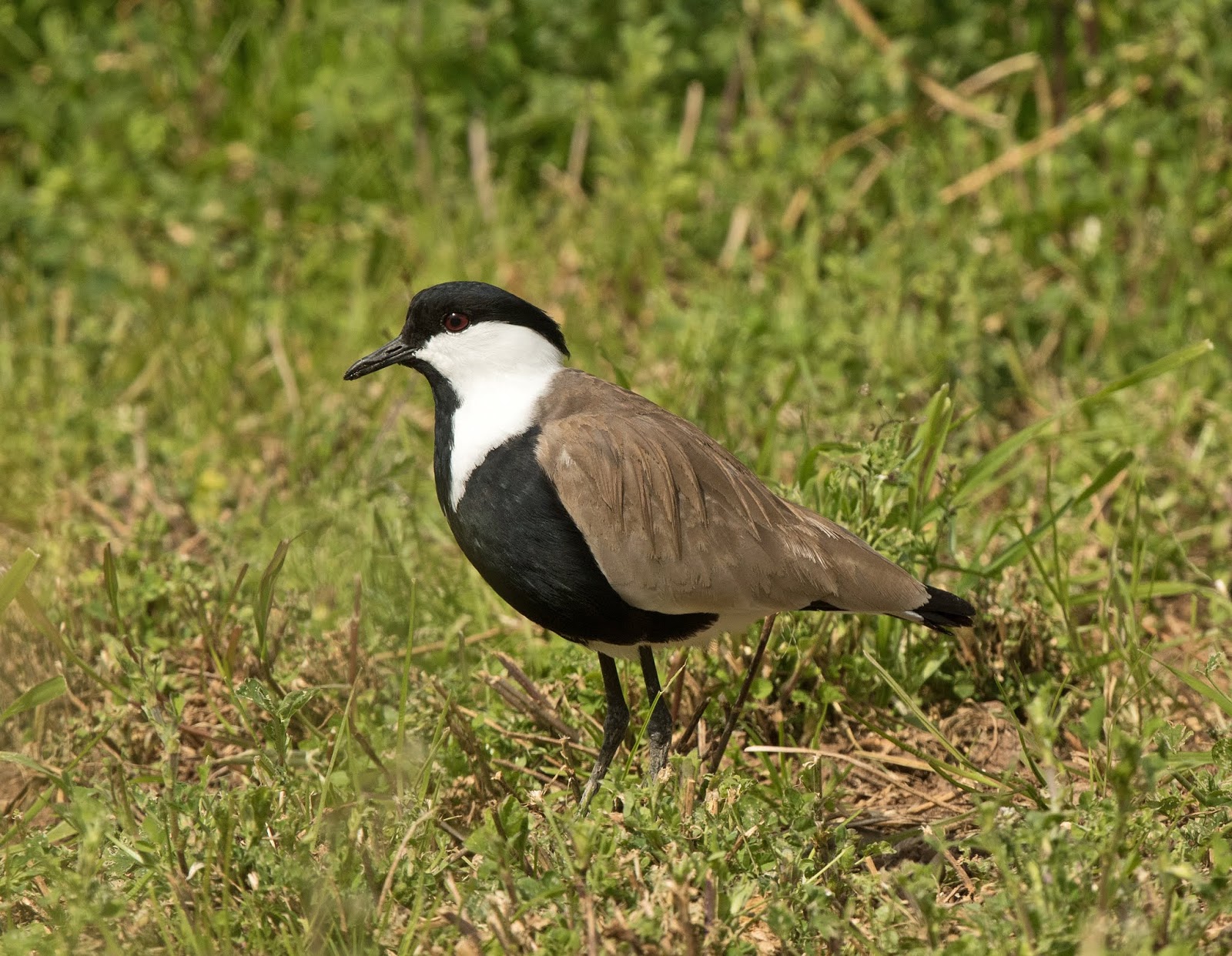
At the sewage works the Spur-winged Plovers had come out to feed in the adjacent fields and the mobile hide paid dividends. Not only did I get the plovers but a nearby Chukar gave me a life tick. A supporting cast of Cattle Egret, Laughing Dove and a host of Spanish Sparrows, none of which presented themselves for a photograph.
 |
| Spur-winged Plover |
 |
| Spur-winged Plover |
 |
| Spur-winged Plover |
 |
| Spur-winged Plover |
 |
| Chukar ! Not the most salubrious of surroundings - but happy to record it |
I drove round Mandria Beach but found little other than a large flock of larks at "lark corner" so I made haste for the Asprokremmos Dam. By the time I reached the dam ominous clouds were gathering and I felt a few spots of rain. During the winter Cyprus has experienced heavy rainfall and this was evident as the dam was full, almost overflowing. I walked across the barrage, putting at least ten Chukar off the dam wall. In the far corner I found a Blue Rock Thrush but the light was poor and the shots I took are pretty grim. I walked down the path towards the river bed at the bottom and found quite a few Ophrys flavomarginata but precious little else. The heavens opened and I decided that it was time to head back to the hotel for a late afternoon "cuppa". All in all an auspicious start to the holiday.