Pages

Tuesday, 16 February 2016

More Fuerteventura Birds and Butterflies

 
Late one afternoon we staked out the fig trees on Tindaya Plain, hopeful that a Houbara would turn up. To say it was slow was an understatement, just two Cream-coloured Coursers ambling by.


Then the resident Raven entertained us, dining on the old figs, the heat was soporific but when a large, odd looking, brown animal crossed the road just yards in front of us I was bolt upright and wide awake. I had never seen anything quite like this and between us we hadn't got a clue to its identity, two more appeared, this time behind the car and further away, but I managed a quick shot. Subsequent research reveals that they are Canary Island Wild Dogs, take a look at the coat of arms of the islands - guess what? Two big brown dogs!


The final surprise came as three large Yellow-legged Gulls landed close by and joined the Raven feeding on whatever insects were popping up in what is virtually a desert.


We couldn't leave without a final visit to the agricultural areas around La Oliva. When we arrived a Kestrel was terrorising a flock of Trumpeter Finches, What a hoot, the birds sat on the top of a berm and directed a constant stream of alarm "Paaaaarps" at the post squatting Kestrel.


I finally investigated the Shrike's nest and recorded the juveniles.


As we left, one last Hoopoe graced us with his presence.


Whilst the primary targets for the holiday were avian oriented I couldn't ignore the chance of some exotic butterflies. I knew that Monarchs could be found at Betancuria and that Plain Tigers occurred in the car park at the Oasis Park Zoo down in La Lajita. Also a posting on Sussex Butterfly Conservation by Neil Hulme suggested that the place was alive with the African Grass Blue, Zizeeria knysna  so I was disappointed not to find one. Another mistake was not to photograph the large whites, I had dismissed them as "too common" when they are possibly are a separate species from our UK residents. Tolman states that Pieris brassicae are not known to occur in the Canaries - others disagree.


My holiday list:

Canary Islands Large White, Pieris cheiranthi??   La Oliva but everywhere in shaded 
greenery

Small White, Artogeia rapae                                     La Oliva but everywhere

Green Striped White, Euchloe belemia                    La Oliva

Painted Lady, Vanessa cardui                                  everywhere in huge numbers.

Red Admiral, Vanessa atalanta                                 La Oliva

Common Blue, Polyommatus icarus                       Tindaya Plain

Geranium Bronze, Cacyreus marshalli                    La Oliva and Betancuria

Lang's Short-tailed Blue, Leptotes pirithous           La Oliva and Rosa de los Negrines

Monarch, Danus plexippus                                        Betancuria

Plain Tiger, Danaus chrysippus                                Oasis Park, La Lajita

Greenish Black Tip, Elphinstonia charlonia             Rosa de los Negrines and El Cotillo

I haven't done any butterfly photography in hotter climes before and failed to realise just how active and unapproachable they can be. The Plain Tiger never came close enough for a macro shot so I resorted to using my 400mm f5.6 - it was either that or climb up into the ornamental flower beds at the zoo. Well that's my excuse anyway.

The Monarchs were deceptive too - they seemed to flop about but were actually quite quick and never really settled. The most obliging subject was the Lang's I had three and when the sun went in they posed perfectly. Whatever, here is what I managed to capture.


Geranium Bronze


Green Striped White


Lang's Short-tailed Blue


Monarch


Plain Tiger


Wednesday, 10 February 2016

Fuerteventura Birding (3)

It would be a hard act to follow the Houbara episode but I had a plan and several more birds that I wanted to see. So after breakfast we headed off for the Embalse de los Molinos, Fuerteventura's largest expanse of freshwater. Turning off the road at Las Parcelas we scanned the goat farm - alas no birds present just the usual large and angry dogs. As we approached the dam we were greeted by a Southern Grey Shrike - they literally are everywhere. Amazingly we had the place to ourselves so took time to scan the water. Ruddy Shelducks are obvious - there must have been at least 300 on the water and scattered on the banks, all making a tremendous noise. We also found Coots, several Black-winged Stilts, there should have been more but the water levels were high and there was minimal exposed mud. In fact we found more when we visited the other end of the dam.


The bird that I really wanted to see was the Fuerteventura Stonechat, normally known as "the chat" and according to reliable information two pairs inhabited the barranco below the dam. So I set off down the track into the valley, the temperature on the top was a pleasant 22 degrees, at the bottom where there was no wind it was uncomfortably warm! No matter, as I reached the river bed which had a good trickle of water flowing, I was greeted by a very obliging male chat who was soon joined by his mate - an easy life tick and good photos to boot. I continued down the path and soon found the second pair and a third male interloper.


Berthelot's were everywhere and I also flushed Common Sandpiper, Green Sandpiper and Little Ringed Plover.  Ruddy Shelducks, Pied Wagtail, Little Egret and Trumpeter Finch completed the list. There is no doubt that water is the key to good birding on a desert like island. I noted lots of dragonflies, damselflies and other interesting insects but I concentrated on the birds, mentally noting that a return visit would be in order. Ha! - the weather on my subsequent return was much cooler and a half gale was blowing down the barranco - not an insect to be found. One of the dragonflies was obvious - the Lesser Emperor but of course all were hyperactive in such heat.  As my water supply ran out I thought that I should return to the car - we had other birds to see.

Down at the other end of the dam there is a massive goat farm and the Black-bellied Sandgrouse take advantage of the feed put out for the thousands of goats. Sod's Law prevailed all the goats were in the most distant fields though there were literally hundreds of sandgrouse flying about - mainly between the barranco and the goat fields. Don't be put off by the entrance to the farm - just drive to the end of the track and park adjacent to the blue containers. Anyone we saw just waved, not the same as in the UK where the usual greeting is "get orf my land"

The path down to the barranco is a bit precarious but it is well worth it, I finally got some shots of BbS, albeit at a distance and the Black-winged Stilts obliged.


Black-bellied Sandgrouse - my holiday bogey bird - perhaps next time!


Time to be off again, this time Betancuria where the African Blue Tit can be found, I also wanted to find a Monarch butterfly and as the temperature was on the up I was confident. Immediately after we had parked in the lower car park, 1 euro for the whole day, about one thirtieth of what Brighton City Council charge, I saw a "lolloping" Monarch and managed some shots. Just a few more yards into the town and I heard the distinct tones of an African Blue Tit, not vastly different from our home grown variety. We waited patiently and sure enough one emerged and posed for us.


In the town centre Monarchs were everywhere, so whilst Liz went shopping I staked out a patch of Decaisne's Viper's Bugloss and Bougainvillea. Plain Tigers had been reported but I saw none, though whilst snapping the Monarch I was photo bombed by a hyperactive Striped Hawk Moth which I just managed to capture. 


On return to the car park I heard the scratchy call of a Sardininan Warbler, sure enough, in the palms right next to the car there were three of them and not one would come out into the clear to be snapped. God knows what the other tourists thought of the mad Englishman peering into the bushes.


Finally, exasperated, I gave up as there was one more place to visit - the Mirador de Las Penitas where I had a date with some well known Ravens.


After a long drive, some of it through some narrow mountain roads, we arrived back at the hotel and had a well earned drink to celebrate a very successful three days, time for rest and some shopping in Caleta de Fustes.

Tuesday, 9 February 2016

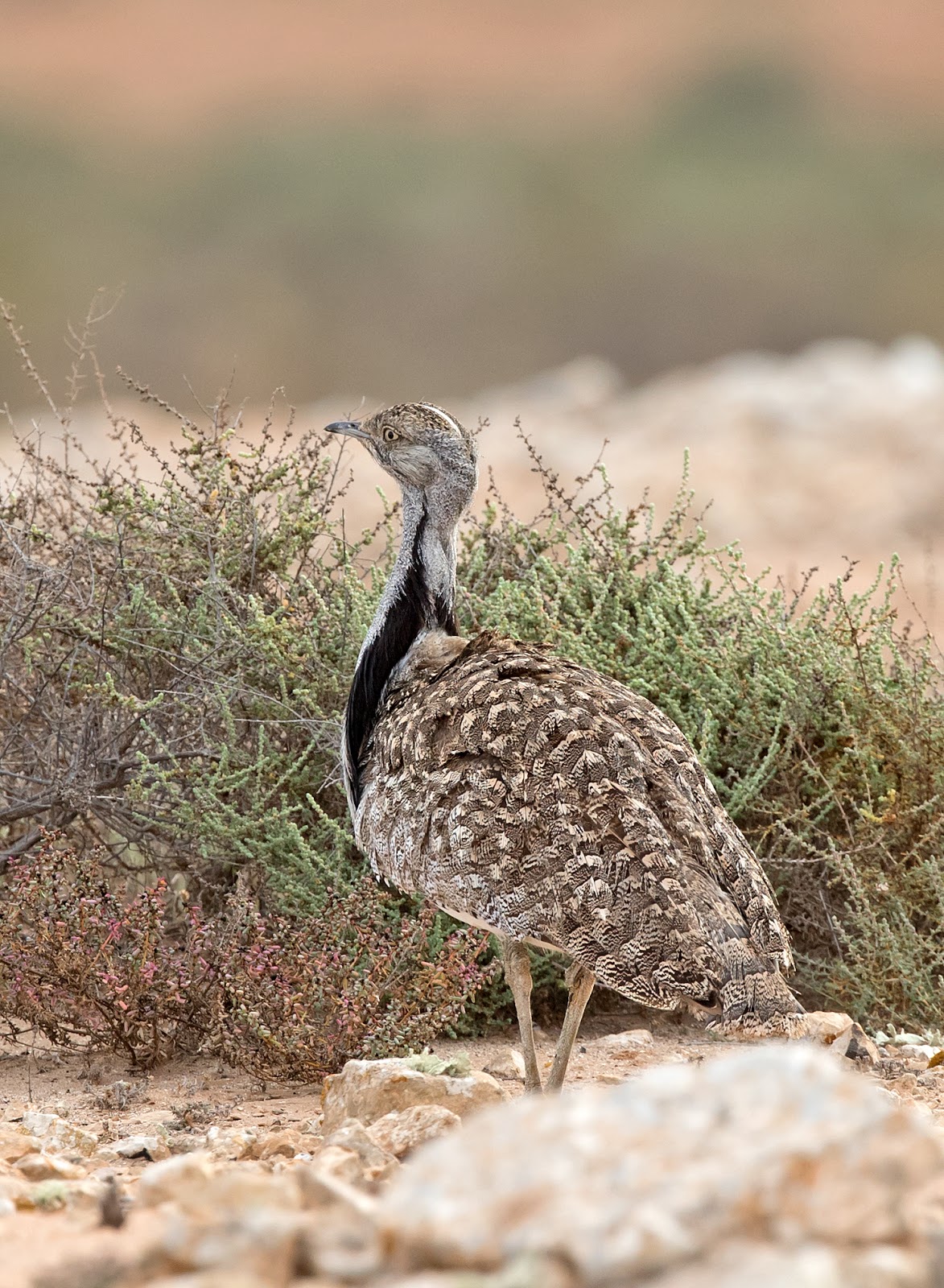
Houbara Bustard

The quality of the birding on Fuerteventura is excellent but it is the desert birds that command the most attention, particularly the Houbara Bustard with its quirky display behaviour. Whilst their locations are well known, finding one depends a lot on good fortune. I have to say that if it hadn't been for the information I received from other kind birders I would probably have dipped this species. Having missed a bird on Tindaya Plain the previous day my confidence levels were low. Never mind I was in the right place at the right time and two very kind birders from Germany allowed me to share an hour of great spectacle.

I had left the hotel in the dark, heading for Rosa de los Negrines, just a few kilometres north west of La Oliva, following the directions of another birder. The bird normally produces its display early morning and late in the day, the rest of the time it skulks in the desert landscape and is very difficult to find.

This particular bird was fairly distant and given the early light I struggled to get any quality in the shots and I was unprepared for how fast the bird moves during the actual display - headless chicken act is a most appropriate description, as it buries its head in a shower of white breast feathers and runs round in a circle. Today this happened twice and I didn't really connect. I had the impression that the bird would have remained in the vicinity if it had not been for two mountain bikers and a succession of high speed lorries making their way to the quarry at the end of the track, it finally departed, creeping north into the fenced off area.


Rosa de los Negrines from the Houbara location

Monday, 8 February 2016

Fuerteventura Birding (2)

After a leisurely breakfast we made our way to the Tindaya Plain, an easy journey from La Oliva. Now I know the purist would say that we should have left at first light to see the desert birds at their finest, well I am mighty glad we didn't try to negotiate the road from Tindaya to Taca without full light. The winter rain takes a massive toll on the roads, huge cracks and potholes that could destroy the suspension of a small car like our Polo. It was bad enough as I, of course, scanned the expanse of  near desert for birds, whilst Liz kept shouting "Watch out"  - for a pothole - not a bird.

After yesterday's cornucopia of birds we had definitely got a famine on our hands, after several kilometres all we had seen was a Southern Grey Shrike, a pair of argumentative Ravens and a Kestrel that inhabited the ruins on the right of the road. Two Barbary Ground Squirrels entertained us by carrying away lumps of white paper from the road to a secret lair somewhere amongst the vast expanse of broken rock.

We parked up and despair set in until we were overflown by two birds of distinctive shape, but without doubt the bubbling call gave the ID - two Black-bellied Sandgrouse. Then things picked up as the Berthelot's Pipits appeared, followed by several flocks, never more than twenty birds, of Lesser Short-toed Larks. A pattern that held for the week, rarely did we find a single lark and never close. A single Swallow flew arrow like across the road, heading purposefully north.

We did a 180 turn as we approached a tremendous hole in the road that no one in anything less than a 4x4 would attempt. Crawling back towards Tindaya we saw more BbS flying in, it is amazing that as they land amongst the pale coloured rocks they disappear immediately, so good is their camouflage that only movement gives them away. We met other hopeful birders coming down the road, none with exciting news, but we did receive information on where to find Cream-coloured Coursers. We motored back to the fig trees and sure enough several birds were about, at a distance where they could be recorded.


Soon we were joined by other birders and the extra pairs of eyes soon found more BbS. I was distracted by a blue butterfly which turned out to be nothing more than a Common Blue.

A grumpy Raven came in to find some of the figs that were well past their sell by date. Other than that it was very quiet so we left for El Cotillo. I found out later that evening that we had missed a Houbara Bustard that turned up just as we left. Violent waving was wasted as I never looked in the mirror just at the vast expanse of countryside.

El Cotillo was a big disappointment, just two Cream-coloured Coursers in the distance and despite scanning for two hours, nothing else turned up. I did manage a life tick butterfly in the guise of a Greenish Black Tip, in fact several were flitting about but trying to get a photograph was near impossible  as in the heat of the day they are manic.

We returned to the hotel via the Casa de los Coloneles, seeing more of the birds that we had seen on the previous day but nothing more exciting than three Buzzards. A birding tour had mentioned hearing a Barbary Partridge but despite searching and listening for an hour we turned up nothing. Back in the hotel garden the butterflies were active and I found Green Striped White, Geranium Bronze and a very tatty Lang's Short-tailed Blue - all life ticks.


That night. by chance, we decided to dine at the Mahoh restaurant, just up the hill from the hotel.  The food was fantastic but it was even better to meet the same birder who had waved to us at Tindaya. He gave me precise location details for a displaying Houbara Bustard at Rosa de los Negrines - something for which I am eternally grateful.