Way back in October when were suffering under leaden skies and the promise of a hard winter, after all the swans were coming down from Russia early - a sure sign that the UK would be inundated with snow and ice. Ha! - that never happened but it did galvanise us to book a holiday in the Canary Islands. I have always wanted to see and photograph the Blue Chaffinch on Tenerife but research led me to the desert birds of Fuerteventura, the Houbara Bustard in particular. So we booked the flights and a hotel that birders use, just on the outskirts of La Oliva, centrally situated and far from the madding tourist crowd.
First the plugs, if you are going birding in Fuerteventura there are two things that I heartily recommend. The first is a copy of Dave Gosney's "Finding Birds in the Canaries", with its accompanying DVD it is without doubt the best value birding investment that I have ever made. It is worth its weight in gold as the information is spot on - don't travel without it!
The second required item is a mobile "hide" - we had a VW Polo (colour optional) courtesy of Avis, ours was diamond white and the birds didn't seem to mind. It a had developed a distinct "lava dust pink" by the end of the week and we didn't use a whole tank of gas.
The "Field Guide to the Birds of Macaronesia" by Eduardo Garcia-del-Rey is also a very handy book to have available.
So, having been delayed out of Gatwick, heavy winds, we arrived at our hotel just as darkness set in, so no birds on the list on the first day, though squawks and calls from the considerable amount of date palms around the hotel gardens gave me encouragement. Next morning I awoke to a full dawn chorus - hundreds of Spanish Sparrows declaring that this was their territory and that they were willing to fight for it. I opened the bedroom door and stared face to face with one male - I swear he said "Welcome to the Canaries". This choir had a full backing group of raucous Collared Doves - not sure that if I could ever determine an African variety though.
 |
| "Good morning" |
I grabbed my bins and set off on a morning perambulation of the surrounding area, leaving Liz tucked up in a very comfortable hotel bedroom. Just a few hundred yards down the road I discovered a flock of five Hoopoe, a Southern Grey Shrike and Berthelot's Pipit - things really were looking up. I also discovered that every rural residence on the island has a dog, real mean brutes and not all of them contained on their premises. Not wishing to be injured on my first day I reversed my tracks and returned to the hotel. As I walked into the drive I heard the unmistakeable call of the Laughing Dove and I managed to track it down to the roof of a nearby villa, its preferred location for the week that we stayed.

The final icing on the cake was a fly by of an Egyptian Vulture, circling over the road, no problems with the ID as the tail is a dead give away. Oddly enough we only saw two of these throughout our visit, both in the air and I was expecting to find some specimens on the ground although we didn't visit a feeding station. Five life ticks before breakfast on day one - surely it couldn't last.
After breakfast we decided that rather than go any distance we would bird locally in the agricultural areas to the south of the town. This valley manages to retain quite a lot of the rain that runs off the mountain and is always verdant and consequently attracts lots of small birds.
First bird was an obliging Kestrel, not surprising as they are very common on the island, there are of course several races but I don't feel qualified to determine which is which so it remains in the log as "Kestrel". Perhaps with the photographs I will make a judgement in the future.
Throughout the island metal fencing is employed either to keep goats in, or out of, agricultural areas, whilst this provides excellent perches for the bird life it isn't the most eye pleasing in photographs but it does make them easier to spot. As we crept along the dusty track we spied a Southern Grey Shrike on the top and he tolerated us until we got close enough for some good shots.
The Spectacled Warblers were a little more flighty , also the Hoopoes were flitting in and out of view constantly. Next up were two Berthelot's Pipits. On this occasion I got out of the car to get a better view and this was the cue for them to walk towards me until they were within my closest focus distance, rather different from birds back home.
Round the corner we came across a perched Corn Bunting that provided close up opportunities, its rasping call could be heard a long way off. It was unusual to find so many Corn Buntings spread out through the whole area, not a bird I was expecting. Barbary Ground Squirrels were popping out of the stone walls but wouldn't pose, just taking a quick look and then making for cover. In a location that came to be known as "Shrike Corner" we found another obliging bird. Finally at the end of the track we found a pair of shrikes and from their behaviour it was obvious there was a nest nearby. Later in the week I explored the area carefully and found three fledged juveniles.
Whilst photographing the SGS I was treated to a fly by of two Trumpeter Finches, so called because of their obvious call, similar to that made by a child's plastic toy trumpet - a bird that I could never tire of seeing and hearing its call - "paaaaahp". However it has a great scientific name too - Bucanetes githagineus!! Shame they didn't pause for a snap.
In true Spanish fashion we quit for lunch and a siesta back at the hotel, well in the end we sat by the pool and watched the frantic coming and going of the sparrows. The pool looked inviting and with a daytime temperature of 24 degrees I thought a dip might be refreshing. However, having dipped a toe in, I decided to give it a miss, I believe the pool had only one taker all week - it takes time for the water to warm up.
In the afternoon we did it over again - back down the same track as I was keen to get some better Hoopoe shots, on the way down the track the squirrels were now happy to pose in the late afternoon sunshine. As always, introduced species are likely to become a pest, but these chaps don't appear to be doing any harm and around Caleta de Fuste the tourists delight in feeding them peanuts, which they take from the hand.
At the end of the track, by a locked gateway, we had a surprise - at least 20 Hoopoes actively feeding but by Sod's Law they stayed the other side of the fence from our parked "hide". One bonus was the arrival of a nice male Trumpeter Finch that posed atop the fence.
As the sun dropped we made our way back to the hotel, in all a great day as we had seen 8 of our target of 22 species and I had amassed 6 life ticks. Liz was amused to see a large pale camel out in the fields with a couple of cows - I just had to take a snap.
For context this shows the green agricultural area to the south and west of La Oliva, in the foreground our hotel, the Casa Vieja and on the right hand side, in the far distance, the Casa de los Coroneles
We decided that with the weather set fair a day's birding in a westward direction would be ideal. So we set off for some of our favourite venues down in the New Forest. First up was Pennington Marsh in an attempt to locate the long staying Long-billed Dowitcher. We had nailed this bird, photographically speaking , last year and I didn't think we would improve on those records during today's visit. In fact we didn't find the bird, not surprising really as the water levels were very high and it could have been anywhere, either in the lagoons or on one of the many flooded fields.
Next was a visit to Mark Ash to find that our reliable Tawny Owl has moved home. The forest was very quiet, just a few Blackbirds, no flocks of Chaffinches to be found. Though it was nice to find a couple of pairs of Stock Doves, exactly where we saw them last year.
On to Eyeworth Pond at Fritham, always good for Marsh Tit and of course a Mandarin or two. A full supporting cast enjoyed the feed we put out and we left with hordes of Great, Blue, Coal and Marsh Tit attacking the bounty with gusto,
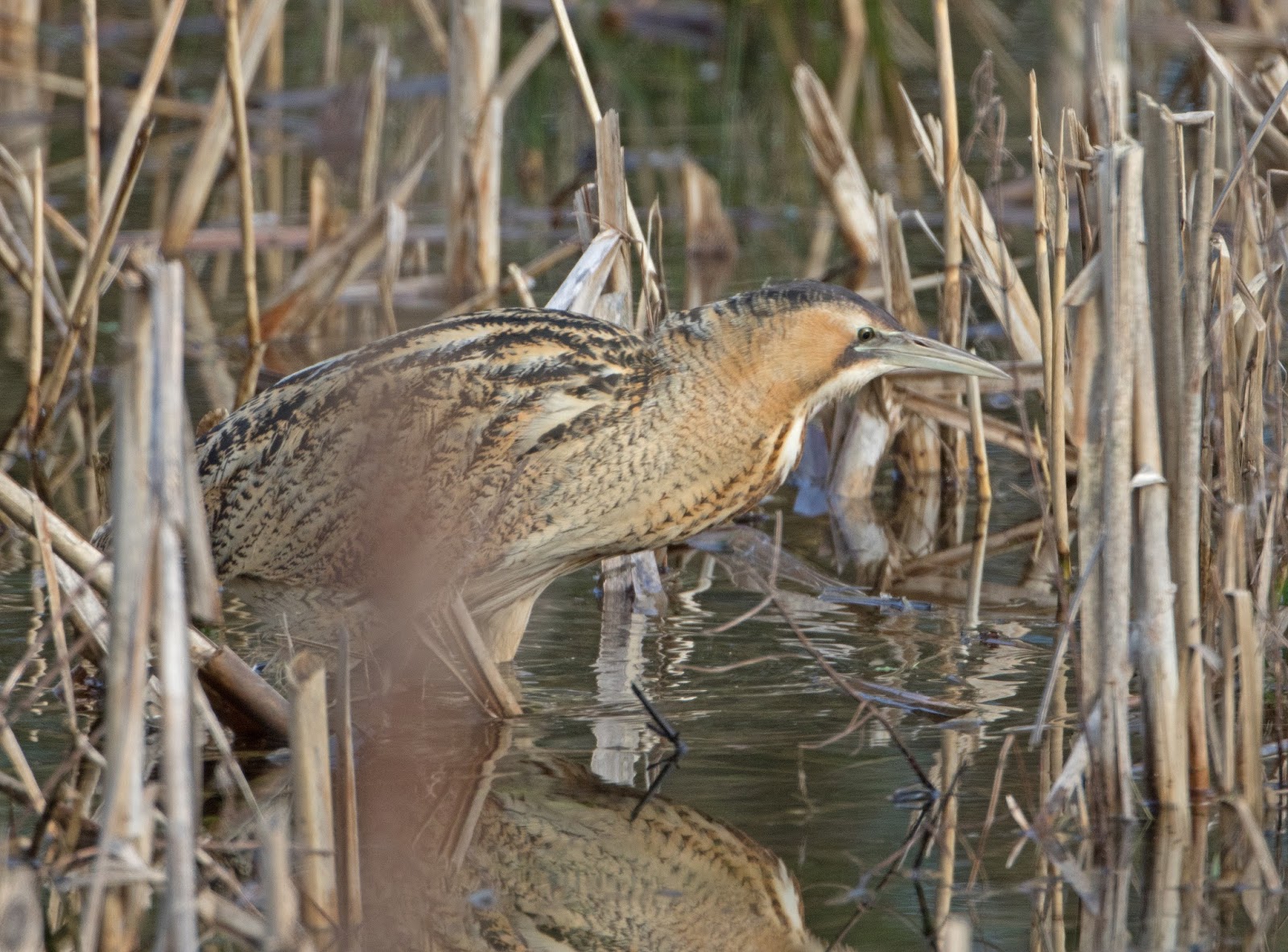
Then a visit to Blashford where we expected to get Goosander and possibly a Ring-billed Gull from the Tern Hide, sadly no Goosanders about but the sightings board indicated that 90+ had been counted recently. On the reserve itself, a mass of Siskins raiding the feeders which I stopped to record, Martin went on to the hide to see if he could find a Brambling, he returned hotfoot with information that the Bittern was showing well from the Ivy north hide.
When we arrived it was quite busy and during our stay became nearly full with birders hoping for a glimpse of the bird. Oddly only one window opens on this hide and there is almost a queue to occupy it, normally a photographer wanting a clear shot as the rest of the windows in the hide are glazed with the most horrendous blue glass. In the end two birds were feeding in the reeds but as always they were hard to find and rarely broke cover.
Not forgetting the Siskins.
We finished the day on a high note for on the way back Martin suggested another go at the Red-necked Grebe that inhabits the channel north of Northney Marina on Hayling Island. Initially we thought that we had a fourth dip on this bird but there it was in the distance - no doubts about the ID as all points were satisfied before the bird decided to make off down stream on the fast ebbing tide.
Some photos from our journey to Minster on the Isle of Sheppey for an obliging Shore Lark, shame the Richard's Pipit at Shellness wasn't in the same mood.
Finally a Firecrest at WWT Arundel that as we followed it along the fence morphed into a Goldcrest and had us fooled for a short time.....
......and a classy Stonechat from Farlington Marsh.
Today was a Rooksbury Mill revisit to see if we could improve the records that we had in December. However, we stopped off on the way at the delightfully named Pinglestone Farm water cress beds. A Water Pipit had been reported and I still haven't got a reasonable shot of one. When we arrived the temperatures were hovering above freezing but it was a bright crisp morning, a good day to be out. There seemed to less birds about than on our previous visit, we did manage to find a couple of likely candidates but given the distance we couldn't achieve a positive ID.
On to Rooksbury Mill near Andover, with the weather remaining clement we were hopeful of some decent photography. The birds weren't difficult to find, more or less where we had left them on our previous foray. This time though there was a small flock of Tufted Ducks, a pair of photogenic Gadwall and a family of Mute Swans.
On the journey home we called in at Pinglestone but there had been no improvement save for eight Little Egrets, smaller birds were absent yet again. After a detour through Petersfield we made our way to an old favourite, the Little Owl at Stapelash Farm, he may have been in residence but if he was he wasn't showing. Similarly the Hawfinches in the trees next to Yew Tree Cottage were obviously foraging elsewhere and I didn't fancy a slog along the path. Then we had a tweet that the Glaucous Gull was back at the gull roost at Goring and as Martin needed the tick we made our way home.
Out on the gap the Glaucous Gull showed well but as I got the camera out it promptly sat down and went to sleep - so no improved shots. By now the biting north-wester was cutting to the bone and the toss up between a steaming hot cup of tea and a shot of a plain white gull was a no brainer. Really nice to be out on a day when the sun shone and that the grey clag has been banished.
With my mobility still restricted I had to find somewhere to go where I could use a lighter set of equipment. Fortunately the three things you need to get Purple Sandpipers occurred today - sunshine, a midday tide and of sufficient height to push the birds on to the top of the East Pier at Newhaven. As the tide peaked at 6.8 metres several of the 16 birds that were hiding under the pier popped up and the conditions were perfect.
If the water doesn't come up high enough you have to shoot down and it can be quite dark.
However, when they come up they are happy to pose for the camera.
Turnstones too, ever on the lookout for a fisherman discarding a lump of bait.